eNews
#03 2026
Not all carbon grows on trees!
By Susan Janse van Rensburg and Michele Toucher
#03 2026
By Susan Janse van Rensburg and Michele Toucher
A new scientific review warns against planting trees on southern Africa’s ancient mountain grasslands — and much of its evidence traces back to research enabled by SAEON’s Cathedral Peak research catchments in the Drakensberg.
Across Africa, governments have pledged to plant trees on millions of hectares of land to help fight climate change. It sounds like an unarguable good. But a new scientific review warns that, in southern Africa’s mountains, planting trees in the wrong place can do the opposite of what is intended. It can dry up streams, feed wildfires, and release carbon that grasslands had quietly locked away for thousands of years.
The stakes are easy to picture. Fewer than 80 breeding Blue Swallows are left in South Africa, out of a global population of under 2 500. Their last breeding grounds are mountain grasslands, and one of the main reasons their numbers keep falling is tree planting in the wrong places. In the Manica Highlands of Zimbabwe, one of these breeding sites was planted with Eucalyptus. The swallows have not been seen there since.
The review — “Southern African mountain carbon: lies, lessons and lighthouses,” published in the Transactions of the Royal Society of South Africa in June 2026 — makes its argument with evidence. And a striking share of that evidence traces back to one place: the Cathedral Peak research catchments in the northern Drakensberg, a long-term research platform run by the SAEON Grasslands Node. The platform was designed with the express purpose of catalyzing cross disciplinary science and providing a platform for students and researchers to advance South African science into the global arena.
Most scientific studies last only a few years. The Cathedral Peak research catchments have been watched for far longer, and that is exactly what makes them so valuable. The SAEON Grasslands Node maintains long-running research observations here, including a distributed network of instruments and decades-old field experiments.
This kind of patient, unbroken record lets scientists ask questions that short projects simply cannot. What happens to the carbon in the soil after 40 years of regular burning? What happens after decades with no fire at all? Answers are only possible where someone has kept measuring, season after season.
The review draws on this directly. It notes that long-term climatic and streamflow records from the Cathedral Peak research catchments already show the tangible fingerprints of climate change: rising temperatures, and more frequent extreme rainfall and drought.
Several of the studies the review leans on come from Cathedral Peak Long Term research catchments, their hydro-climatic data and the long-term Brotherton burning trials.
At the Brotherton Plateau, a fire experiment has run since 1980. Manson and colleagues (2007) found no statistical difference in soil carbon between plots burned every year and plots burned only once every 20 years — though frequently burned soils held less nitrogen. Nearly two decades later, Findlay and colleagues (2022) resampled the same plots. They found soil carbon had actually risen between 2004 and 2019, and that carbon and nitrogen were highest under annual spring burning. This is one of the studies produced with the Grasslands Node, and its lead author, N. J. Findlay, is a co-author of the new review.
In the Cathedral Peak research catchments, Dlamini and colleagues (2024) showed that excluding fire allowed trees to move in naturally — and that this natural afforestation reduced topsoil carbon. Strikingly, more than 40% of the carbon deep in the soil still came from grasses, not the newer trees. Their conclusion was blunt: afforestation and fire suppression in these grasslands can cause a net loss of carbon, along with less water and less biodiversity.
Harrison and colleagues (2025) compared streams in catchments that were burned regularly with those where fire was kept out, and found little difference in the dissolved carbon washing downstream — suggesting the fire regime has limited influence there.
Looking much further back, Lodder, Hill and Finch (2018), working in the Cathedral Peak area, used radiocarbon dating, fossil pollen and chemical fingerprints to reconstruct 5 000 years of vegetation history. Grasslands dominated the whole time; forests expanded only modestly. In other words, these grasslands are ancient — not “deforested” land waiting to be planted.
A related study, Dlamini and colleagues (2025) in the Drakensberg, showed how afforestation followed by wildfire and heavy rain can trigger severe erosion, sweeping soil carbon downhill.
Together, these studies tell a consistent story: in these mountains, fire is natural, and — kept at a sensible frequency — it does not drain soil carbon, and may even help hold it in place.
The review was written by a large team. Five of its authors are affiliated with the South African Environmental Observation Network (SAEON): G. T. Feig (EFTEON), L. X. Dlamini (SAEON Grasslands Node Research Associate /RU), K. G. Smart (EFTEON), M. L. Toucher (SAEON) and S. Janse van Rensburg (SAEON). S. Janse van Rensburg coordinates the SAEON Grasslands Node, and runs the Cathedral Peak platform under the scientific direction of the Node’s Scientists, Dr Michele Toucher.
What the review found — and why it matters
The review’s central point is that labelling southern Africa’s mountain grasslands as “deforested” is misleading. These are ancient, fire-adapted systems, and most of their carbon is stored safely underground, where it stays relatively stable even when the grass above burns.
Planting alien trees on them, the authors argue, carries real risks. Plantations use more water than grasslands, raise the risk of fire, and can lower soil carbon. The carbon that trees store above ground is also vulnerable — a single wildfire can send it straight back to the atmosphere.
The authors are careful not to be anti-tree. Restoring natural forests where they belong remains important. Their warning is specifically about planting trees on naturally open grasslands, often in the name of “offsetting” carbon.
They also point to what works. The review highlights four “lighthouse” projects that conserve carbon, water, biodiversity and livelihoods together: community-based restoration at Gorongosa in Mozambique, carbon-funded rangeland stewardship through the Meat Naturally initiative in South Africa, the protected grasslands of the uKhahlamba Drakensberg Park, and the cross-border Maloti–Drakensberg conservation area. The paper closes with ten research questions still to be answered.
Why does this matter beyond science? Southern Africa’s mountains are its “water towers.” The Lesotho Highlands Water Project, for example, sends water from these mountains to Gauteng, the region’s economic heart. Get the land use wrong and you threaten water security, biodiversity such as the Blue Swallow, and the livelihoods of people downstream. With Phase 2 of South Africa’s carbon tax due to create a local carbon market, the pressure to plant trees for carbon credits is only growing — which makes getting the science right more urgent, not less.
The review sums up the shift in thinking with a simple phrase: the goal should be “carbon for soils, not soils for carbon.”
None of this could be said with confidence without long-term places to measure it. The Cathedral Peak research catchments are one such place — a quiet, decades-long record in the Drakensberg that is now helping to steer how a whole region thinks about trees, grass and carbon.
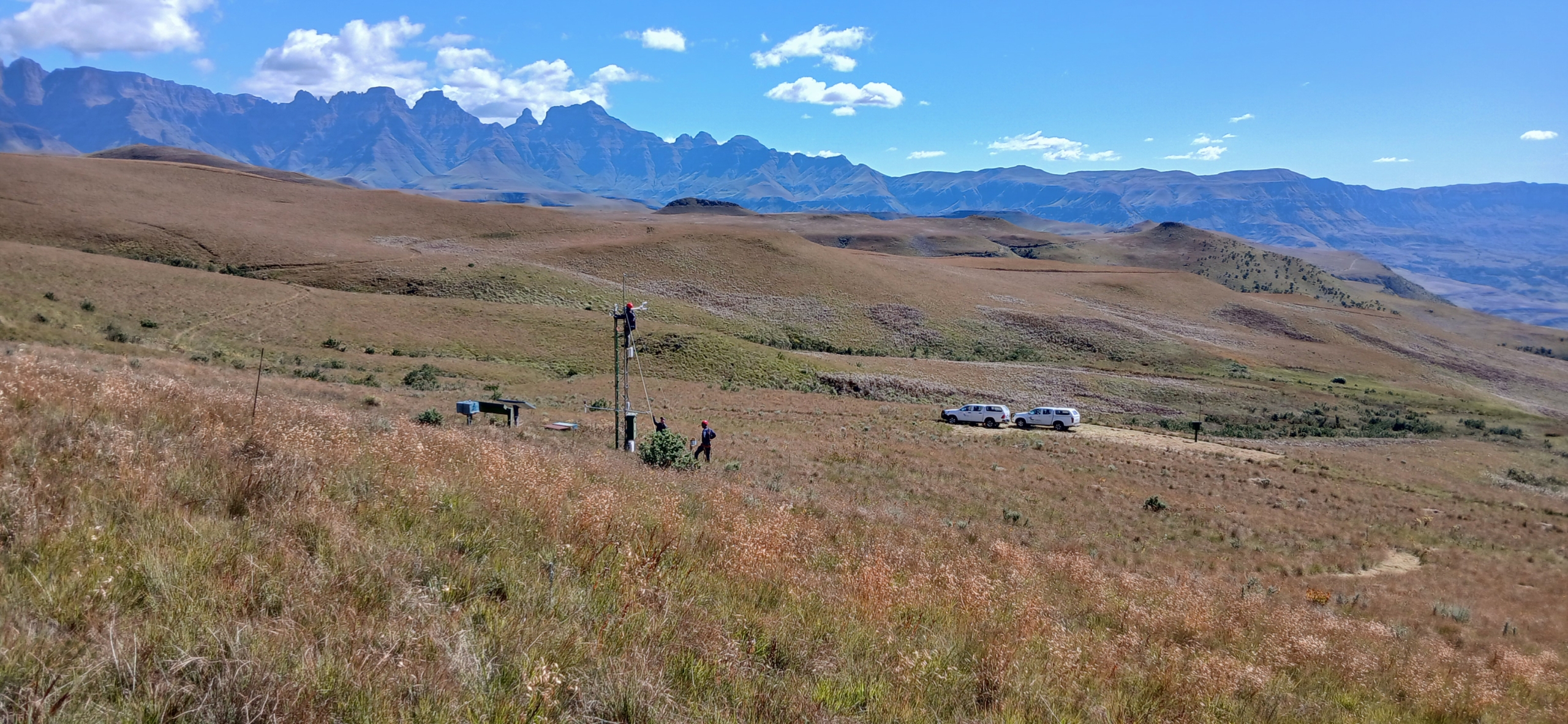
The Cathedral Peak research catchments, a long-term SAEON Grasslands Node platform whose decades of data underpin the new review.
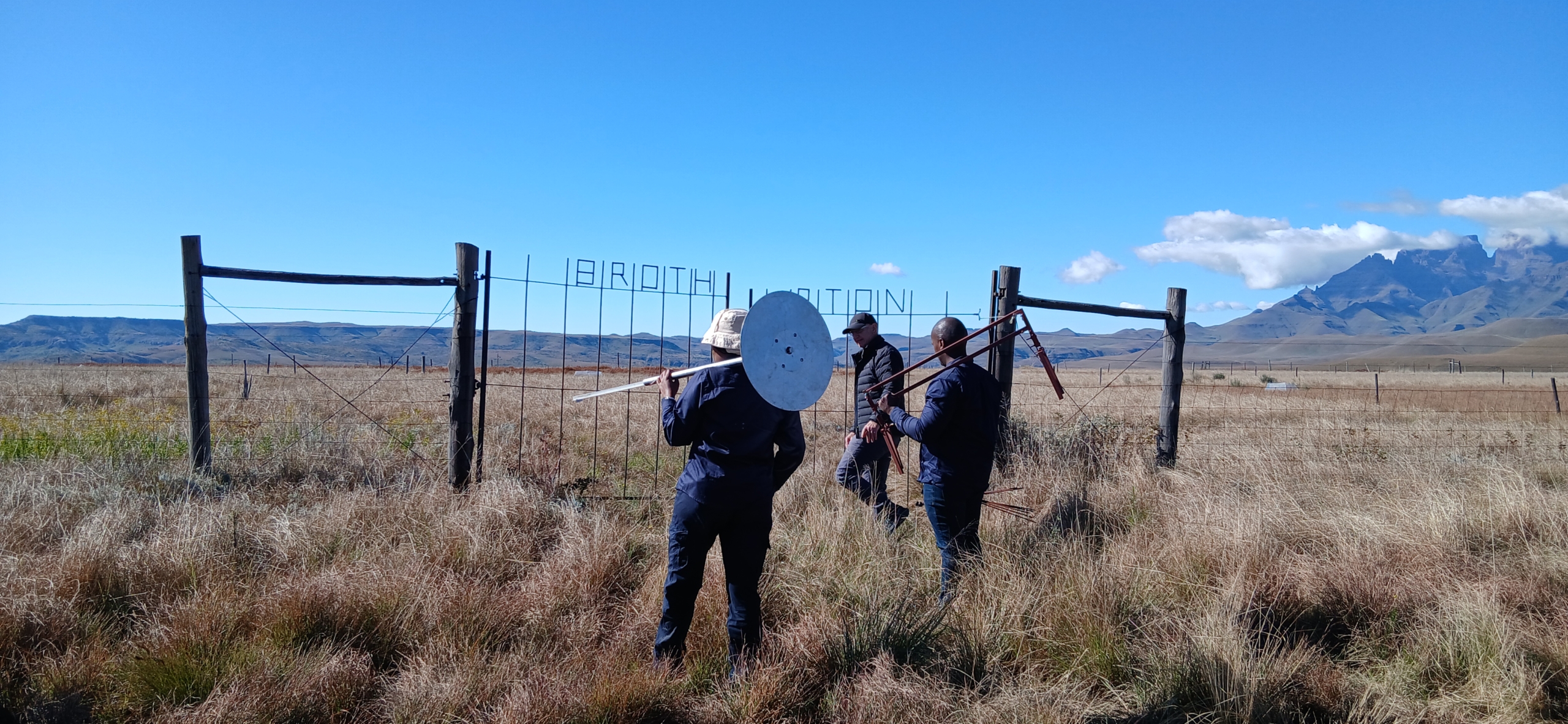
Fire experiments running since 1980 show that regular burning does not deplete — and can even sustain — soil carbon in these grasslands.
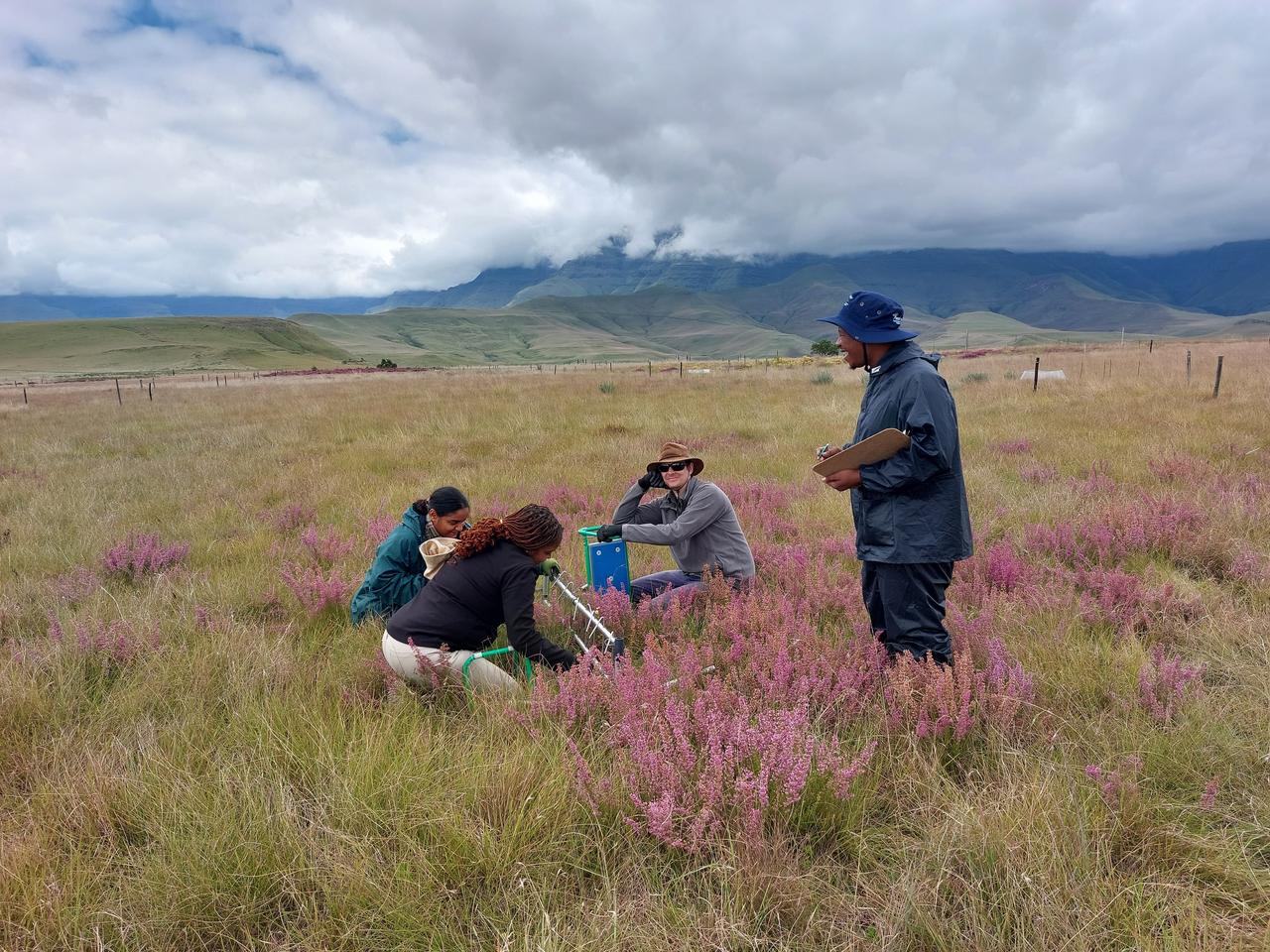
Various students (authors cited) working at Cathedral Peak.
