eNews
#03 2026
Decades of taxonomic research add more than 1,000 new marine benthic invertebrate species to South Africa’s list.
By Kathryn Morrissey & Lara Atkinson
#03 2026
By Kathryn Morrissey & Lara Atkinson
When most people think of South Africa’s marine life, they picture whales, great white sharks, or colourful reef fish. Yet these iconic animals represent only a small fraction of the country’s extraordinary marine biodiversity. Hidden beneath the waves on the seabed, is a vast and largely unseen world of invertebrates such as sponges, corals, sea slugs, sea stars, crabs, worms, sea cucumbers and countless others that form the foundation of healthy marine ecosystems.
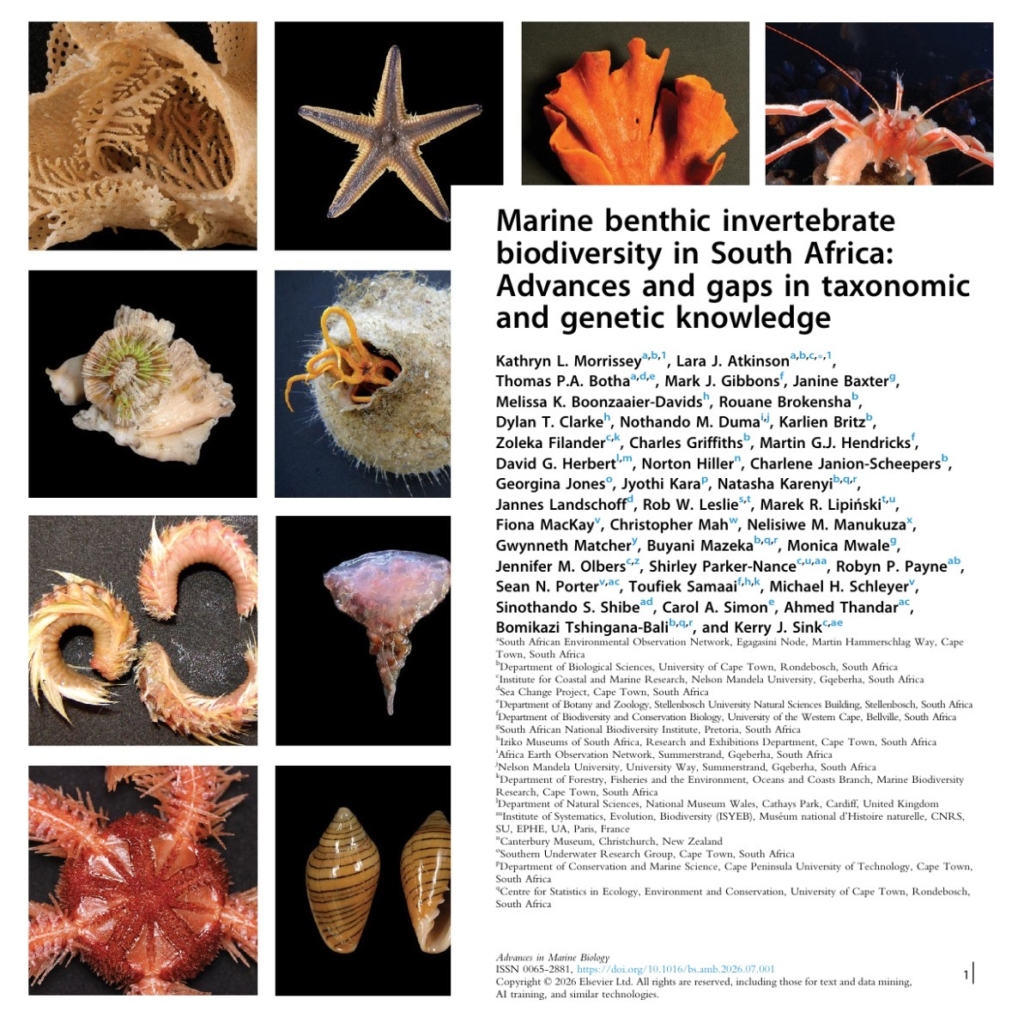
Our new book chapter, Marine benthic invertebrate biodiversity in South Africa: Advances and gaps in taxonomic and genetic knowledge (https://doi.org/10.1016/bs.amb.2026.07.001), published in Advances in Marine Biology Vol. 104, brings together a team of marine ecologists and taxonomists to deliver the most comprehensive update of the country’s marine benthic invertebrate biodiversity in over a decade.
This chapter builds directly on two previous foundational national assessments i.e. Gibbons et al. (1999) and Griffiths et al. (2010), providing the first comprehensive update in 16 years. Accounting only for the additional benthic invertebrate species added through this chapter, South Africa’s known total marine diversity almost certainly now exceeds 14 000 species.
For the first time, each taxonomic group covered in the chapter is accompanied by a permanently citable, open-access species list with its own Digital Object Identifier (DOI). A total of 22 DOI-linked species lists spanning 11 marine phyla are available for download, ranging from sponges and cnidarians to echinoderms, molluscs, crustaceans and others. The citable DOI-linked lists provide a new benchmark against which future changes can be measured, making South Africa’s invertebrate biodiversity data more accessible and useful than ever before.
South Africa is recognised as one of the world’s marine biodiversity hotspots, where the Atlantic and Indian Oceans meet to produce exceptional diversity and high endemism. Since the 2010 assessment, researchers have added more than 1,000 marine benthic invertebrate species to the country’s known fauna spanning intertidal habitats to the deep-sea, some of which are found nowhere else on Earth.
Behind every new species lies years of painstaking work: collecting specimens from remote coastlines and deep-sea expeditions, comparing microscopic anatomical features, examining historical museum collections, and generating DNA sequences to confirm whether an organism truly represents a species new to science.
One of the chapter’s strongest messages is the enduring value of natural history collections. South African museums, including the KwaZulu-Natal Museum, Iziko South African Museum, and the South African Institute for Aquatic Biodiversity house hundreds of thousands of marine specimens collected over more than a century, and many continue to yield new discoveries today. Advances in imaging and integrative taxonomy now allow researchers to revisit these collections, revealing overlooked species without collecting additional specimens.
At the same time, DNA barcoding, genomics and environmental DNA (eDNA) are transforming biodiversity discovery, uncovering cryptic species, resolving long-standing taxonomic uncertainties, and rapidly characterising complex marine communities. Genetics does not replace traditional taxonomy; the greatest advances come when molecular data are combined with morphological expertise in an integrative framework.
Despite encouraging progress, many marine invertebrate groups remain poorly understood. Active South African taxonomic specialists are lacking for several phyla, deep-sea habitats are under sampled, and molecular reference databases remain incomplete. South Africa almost certainly harbours many more undescribed species awaiting discovery.
Knowing what species exist is far more than an academic exercise. Accurate species inventories underpin marine conservation, environmental impact assessments, fisheries management, invasive species detection and climate change monitoring. They also form the foundation for biotechnology and marine natural products research, where novel compounds from marine invertebrates hold significant potential for drug discovery.
The chapter sets clear priorities for South African marine biodiversity research including expanding taxonomic capacity, investing in museum collections, strengthening DNA reference libraries, increasing deep-sea exploration and supporting long-term biodiversity monitoring. These recommendations come at a critical time as global efforts accelerate to document and conserve biodiversity under rapid environmental change.
South Africa now has its most comprehensive picture yet of its benthic marine invertebrate fauna, enriched, for the first time, with permanently citable, DOI-linked species lists freely available to researchers, managers and policymakers worldwide. Despite decades of dedicated work, we have only begun to uncover the extraordinary diversity hidden beneath our seas.
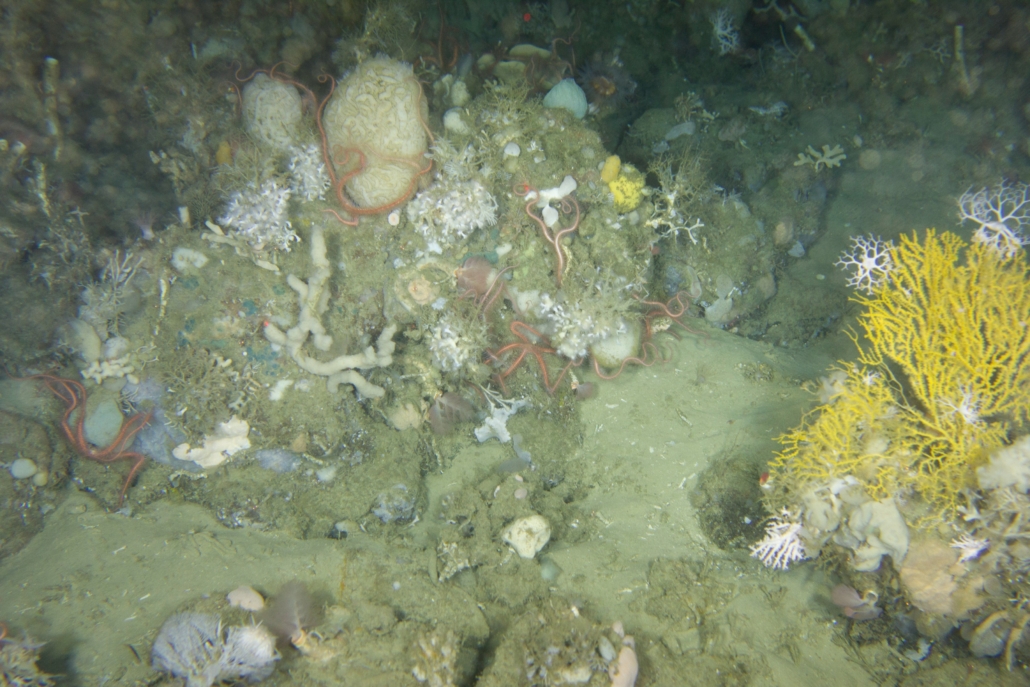
Seabed biodiversity near Childs Bank.
