eNews
#03 2026
New Research Provides Insights into How South Africa’s Offshore Benthic Ecosystems Function
By Jordan Van Stavel, Research coordinator, LTO Ocean Integrated Facility, SAPRI

#03 2026
By Jordan Van Stavel, Research coordinator, LTO Ocean Integrated Facility, SAPRI
A recent study published in Marine Pollution Bulletin by Jordan Van Stavel, Lara Atkinson, Juliet Hermes and Tamaryn Morris https://doi.org/10.1016/j.marpolbul.2026.119693 as part of Jordan’s Master’s research reveals new insights into some of the unseen processes shaping South Africa’s offshore benthic ecosystems.
Offshore benthic ecosystems are among the least explored environments in the world, with much left to be discovered about how these marine communities function. Epifaunal invertebrates, the organisms that live on, protrude from, are anchored in, or attached to benthic substrata, form a key component of benthic ecosystems. These organisms tend to be overlooked, despite the important ecological roles they play, and the valuable insights they provide into overall ecosystem health and functioning. To understand these ecological roles, it is necessary to examine the underlying mechanisms, referred to as ‘biological traits’: the morphological, life-history and behavioural characteristics of organisms that describe their performance, interactions with the environment, and contribution to ecological functioning.
This research investigated patterns in the biological traits and functional diversity of epifaunal communities along South Africa’s continental shelf and shelf-edge. By examining these patterns across the western and southern ecoregions, the study provides new insights into how offshore benthic communities are structured and how they contribute to ecosystem functioning.
Traditional biodiversity studies have focused mainly on identifying which species are present and measuring their abundance. While this provides valuable information for tracking changes in biodiversity, it tells us less about how ecosystems function. For example, two habitats may contain the same species but perform different ecological functions depending on the roles those species play in the environment such as filtering water, recycling nutrients, providing habitat, or scavenging and processing organic matter on the seafloor. This study therefore used a biological trait-based approach, scoring each species according to nine functional characteristics (traits), including body size, mobility, feeding mode, lifespan, and more. This approach provided a more detailed picture of the functional diversity across the 13 biogeographic ecotypes and improved understanding of how species with different traits contribute to ecosystem functioning.
This research drew on six years of trawl-survey data collected by the Department of Forestry, Fisheries and the Environment (DFFE), comprising over 900 sampling stations across 13 biogeographic ecotypes along South Africa’s continental shelf and shelf-edge. Eighty offshore benthic epifaunal species were analysed, including sponges, crabs, sea urchins, various sea stars and other invertebrates.
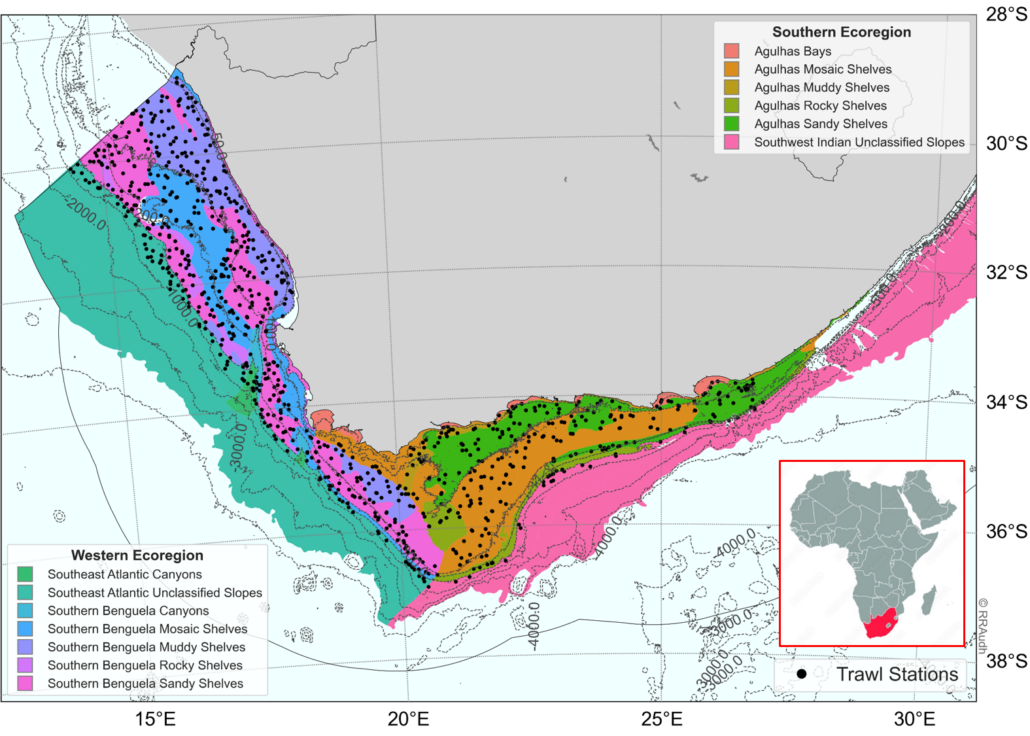
Fig. 1. Map depicting the 909 benthic epifaunal trawl stations (small black dots) from which data used in this study were collected onboard the FRS Africana along the western and southern ecoregions of South Africa. Coloured polygons are used to delineate the 13 biogeographic ecotypes along the continental shelf and shelf-edge of each ecoregion (SANBI, 2022) and the Exclusive Economic Zone (EEZ) is depicted by the black line.
The study revealed that South Africa’s western and southern offshore ecoregions support distinctly different seafloor communities and patterns of functional diversity. In the western ecoregion, soft sediment habitats influenced by the cold, nutrient-rich Benguela upwelling system were largely dominated by a single long-lived sponge species, with relatively similar functional characteristics observed across large areas. In contrast, rocky reefs and submarine canyons supported a greater diversity of species and ecological roles. Deep shelf-edge areas were characterised by large scavenging crabs, which contribute to the processing and recycling of organic matter on the seafloor (nutrient cycling). In the southern ecoregion, which is influenced by the warmer, fast-flowing Agulhas Current, soft-sediments showed greater variation in functional diversity, while shelf-edge communities were characterised by larger, long-lived organisms.
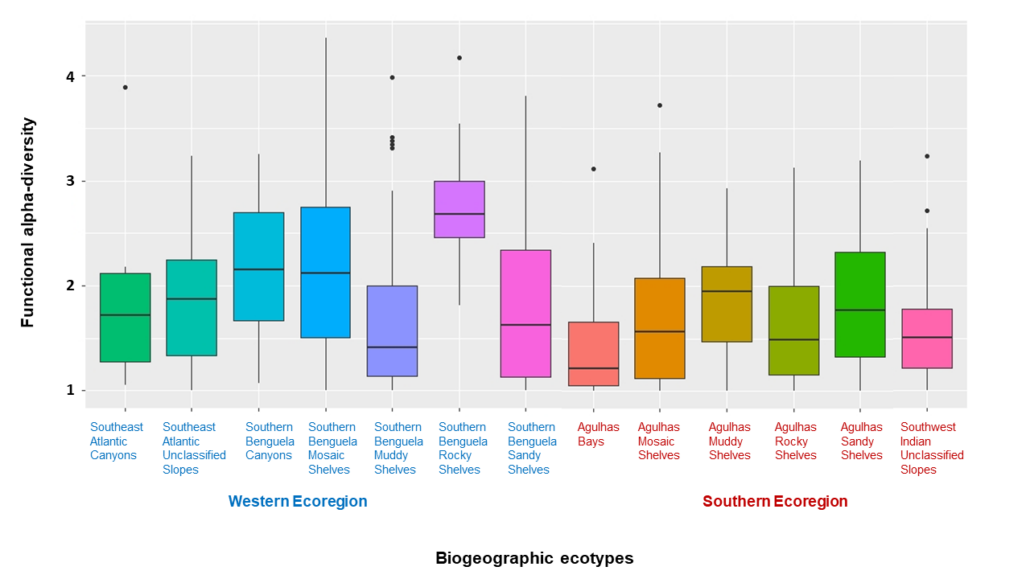
Fig. 2. A boxplot showing the ‘within’ ecotypes functional alpha-diversity index values for the 13 ecotypes in the western (blue) and southern (red) ecoregions of South Africa. Ecotypes are represented by the coloured boxes, and the median (middle quartile) illustrated by the solid black line in each box. Whiskers are illustrated by vertical black lines showing the amount of variation in functional alpha-diversity values within each ecotype. Black dots represent extreme outliers exceeding the maximum quartile.
Understanding these functional differences is increasingly important as offshore ecosystems face growing pressures from climate change, fishing, and other human activities. By focusing on the ecological roles and characteristics of species, trait-based approaches can provide a more nuanced understanding of how ecosystems may respond to environmental change and disturbance.
The findings also have practical value for South Africa’s marine spatial planning and conservation efforts. Protecting habitats that support a wide range of ecological functions helps safeguard the ecosystem services that healthy oceans provide, including productive fisheries, biodiversity, and long-term ocean health.
As one of the first broad-scale assessments of offshore benthic functional diversity across South Africa’s continental shelf, this research contributes to an important knowledge gap and demonstrates the value of trait-based ecology for understanding marine ecosystems. The findings provide information to support marine spatial planning, biodiversity conservation and sustainable management of offshore ecosystems that underpin South Africa’s fisheries and ocean economy.
Data
The biological trait dataset for the 80 epifaunal species is openly available through SAEON’s Open Data Platform (https://doi.org/10.15493/SAEON.EGAGASINI.20250311).
Acknowledgements
This research was funded through the National Research Foundation (NRF) Postgraduate Scholarships, NRF-SAEON Master of Science bursary, NRF SeaMap Grant 138572 and Nelson Mandela University (NMU) Research Scholarships. We sincerely thank the funders for their support of this research. We extend thanks to the Department of Forestry, Fisheries, and the Environment (DFFE) and the crew of the FRS Africana for facilitating the fieldwork and supporting collection of epifaunal data that made this research possible. We thank Dr. Riesna R. Audh for her valuable assistance with the map visualisations presented in this paper.
