eNews
#04 2026
Through the functional ecology looking glass: How do plant functional traits respond to climate and soil in Griqualand West?
By Anika Botha and Nanette van Staden;
NRF-SAEON Arid Lands Node

#04 2026
By Anika Botha and Nanette van Staden;
NRF-SAEON Arid Lands Node
In nature, environmental conditions have shaped and changed species to what they are today. Each with a unique journey characterised by various adaptations to ensure survival. This familiar tale holds true for even the smallest of organisms, to the biggest of giants, and yes, even for the plants encountered in our daily lives—with the plant species of Griqualand West and their treasure trove of tales becoming a part of an MSc student’s daily life…
Griqualand West as a natural laboratory
Griqualand West, located primarily in the Northern Cape and extending into parts of the North West Province of South Africa, is a region with a storied past and considerable economic importance to commercial and communal farmers. It is home to unique plant species found nowhere else on the planet, known as endemic species. This unique flora gives the region high conservation value.
Across the landscape, environmental conditions vary noticeably, with four mountain ranges each characterised by distinct climatic and soil conditions that influence plant growth. From the Ghaap Plateau in the east, with its higher rainfall and nutrient-rich dolomitic soils, to the Langberg in the west, with lower rainfall and nutrient-poor quartzitic soils, the region presents a striking environmental gradient (Figure 1). The Kuruman and Asbestos Hills lie between these two extremes, representing intermediate conditions. Both ranges are underlain by banded ironstone, although the Kuruman Hills receive more rainfall than the Asbestos Hills.
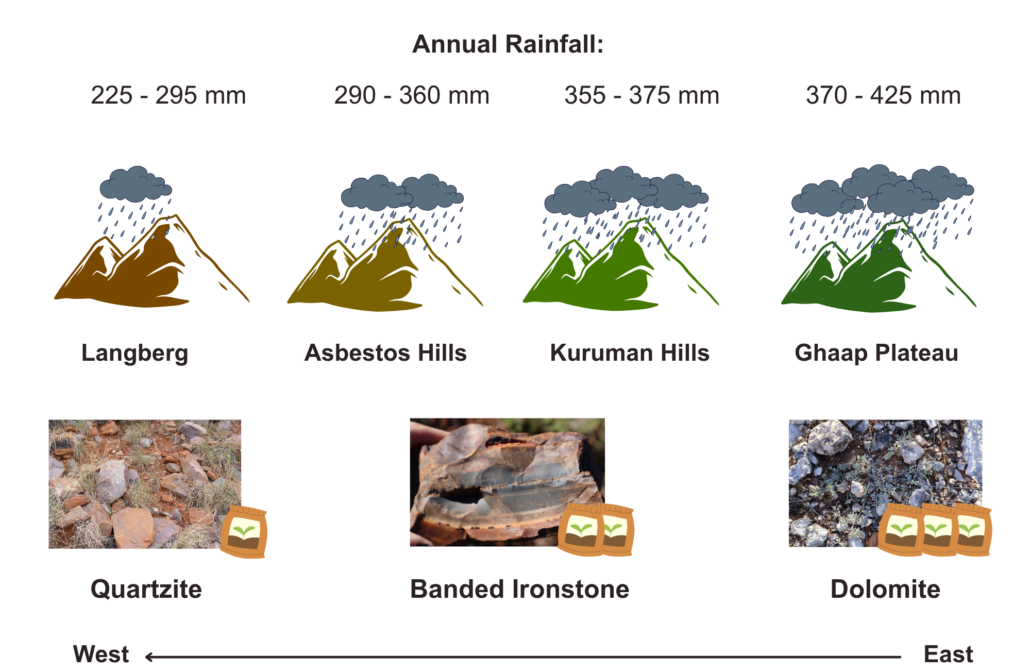
The environmental gradient across the mountains of Griqualand West, based on mean annual rainfall and soil nutrients.
In response to environmental gradients, plants possess certain characteristics, i.e. traits, that help them tolerate and survive in particular environments. These traits can be used as proxies for underlying biological processes and to explain patterns of species distribution and community assembly within a landscape. Thus, by linking specific traits to environmental conditions—in this case, climate and soil conditions—the tale of why certain species thrive under particular environmental conditions in Griqualand West can unfold.
But why do we want to know this? Well, understanding these trait-environment relationships can inform rangeland management by helping us predict which species will persist, produce forage, and recover under different environmental conditions, especially in the face of climate and land-use change. However, while functional trait information is available for some plant species in South Africa’s semi-arid savanna systems, studies examining trait-environment relationships remain limited. Thus, the landscape of Griqualand West provides an unusually well-suited natural laboratory to investigate these relationships, presenting an ideal opportunity to start addressing this knowledge gap through an MSc project.
The project aims to make a meaningful contribution to our understanding of plant functional ecology in this understudied region of socio-economic and conservation importance, which is also home to numerous endemic plant species. Since the project began, it has been a rollercoaster, providing plenty of interesting encounters, unique learning opportunities, and moments of adaptation (and resilience)…
A year at a glance
For much of 2026, progress has felt slow, sometimes moving at a snail’s pace. The first objective was to build the database—a compilation of trait and environmental data from the four mountains and their respective plant species. However, from the outset, the limited and highly uneven distribution of available trait information for the region’s species proved to be the major hurdle. The primary obstacle was standardising the data collection protocol when dealing with such a stark contrast: some species had abundant information, while others had virtually none.
During the search for answers, three interesting realisations emerged. First, there is an ocean of online databases and resources on topics you might never have expected. The second was somewhat saddening: older field guides and books sometimes contained more detailed information than some newer publications. Lastly, the experience highlighted the importance of conversation and human connection. Sometimes, over a cup of coffee or tea, lightbulb moments emerged during discussions with supervisors that were only loosely related to the research.
Undertaking this project has not only provided valuable academic learning opportunities but has also created opportunities to build connections and foster personal growth. It has shown how taking a leap into the unknown, despite uncertainty and doubt, can lead to outcomes one might never have expected…
Highlights, networking and building connections: why conferences are a vital part of the postgraduate journey
One such moment came at the 51st Annual SAAB (South African Association of Botanists) Conference, where Anika presented a poster on her project and stepped outside her introverted comfort zone. She left with cherished new friendships, connections with people from various institutions, and a new role as Vice-Chair of the SAAB Student Council for 2026/2027. Later in the year, she also participated in the UESM (Unit of Environmental Sciences and Management) postgraduate conference at North-West University (NWU). The conference offered interesting insights into the research being conducted across the school’s various disciplines, as well as an opportunity to reconnect with fellow postgraduate students, network, and learn from one another.
Final thoughts and the way forward
This project arose from the need to deepen our understanding of trait-environment relationships, demonstrating their importance while highlighting a sinkhole-sized knowledge gap. Yet, it has also unfolded into a journey of personal adaptation and learning to respond to changing and challenging circumstances. While the project is only halfway complete, it has already opened many doors and introduced Anika to new people, each with so much to teach and share.
The next steps are to finalise the database, begin the statistical analyses and write up the MSc thesis, with a couple of publications hopefully on the horizon and thesis submission planned for November 2027.
For now, the journey continues, with new questions to explore, lessons to learn, and hopefully a few more discoveries along the way…
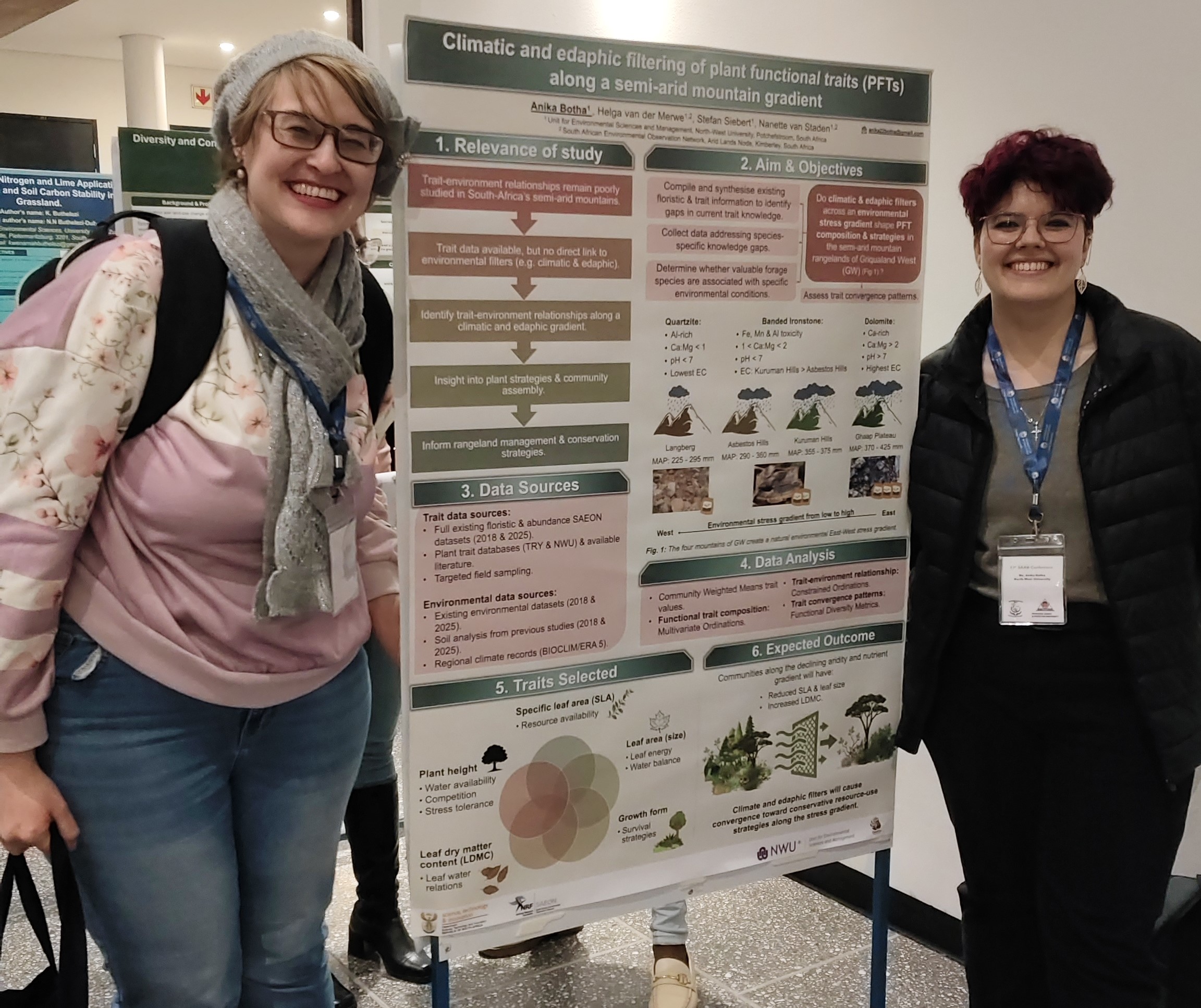
Anika (MSc) with one of her supervisors, Dr Nanette, alongside her poster presented at the 51st SAAB Conference.
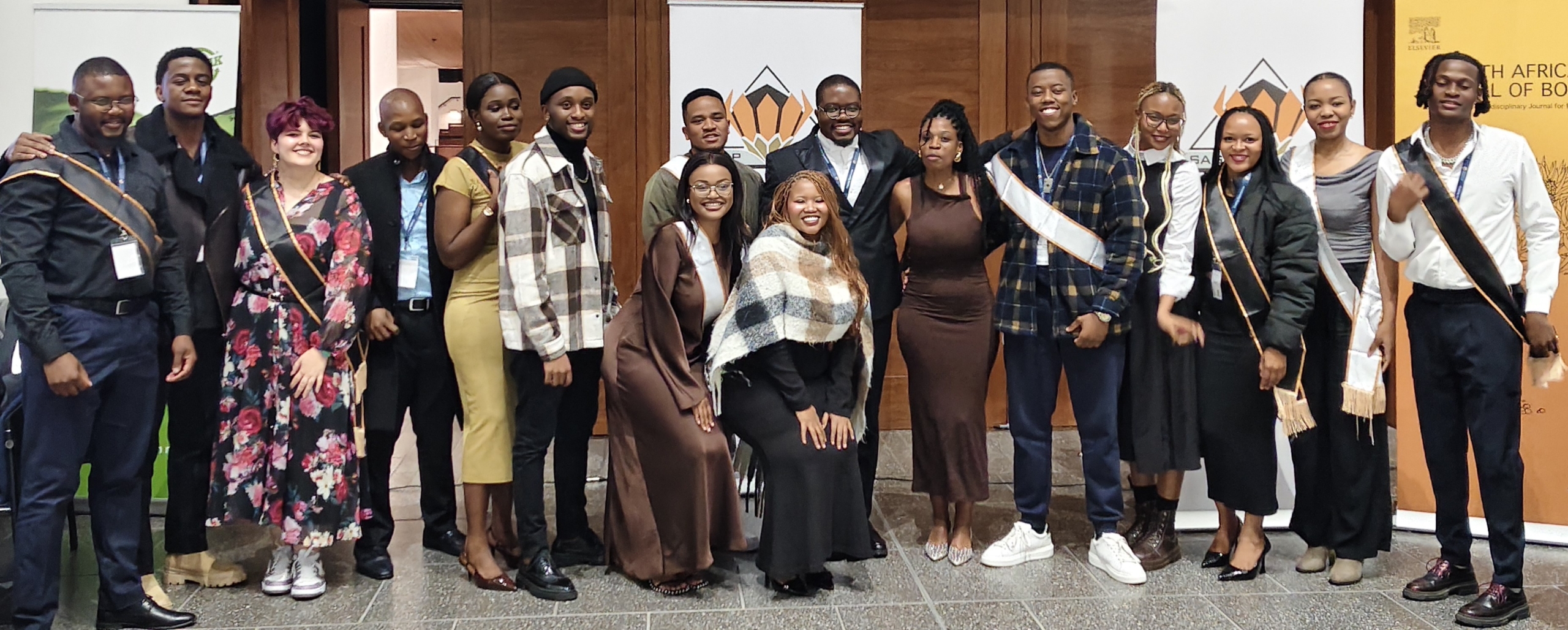
The SAAB Student Council for 2026–2027.
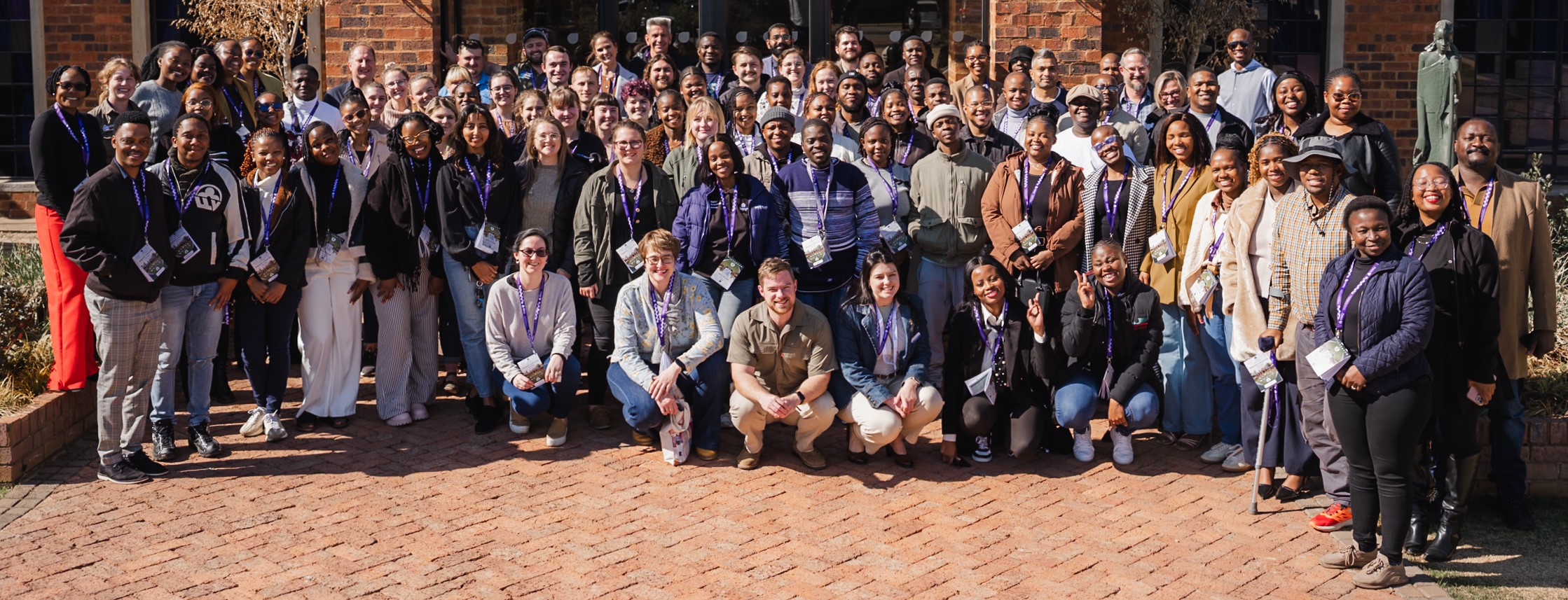
Group photograph of attendees at the 2026 UESM Postgraduate Conference. (Photo: Tiaan Botha)
