eNews
#04 2026
Shaping Africa’s Marine Future: Inside the OPERA & African Digital Twin Workshops, Cotonou, Benin, 12-16 October 2026
By Nkululeko Lerato, Junior Operational Ocean Modeller NRF-SAEON: Egagasini
#04 2026
By Nkululeko Lerato, Junior Operational Ocean Modeller NRF-SAEON: Egagasini
The second OPERA workshop took place from the 12 to 14 of October in Cotonou, Benin, under the great hospitality of the University of Abomey-Calavi through the UNESCO International Chair of Mathematical Physics and Applications. The other local co-hosts were the Benin Institute for Halieutic and Oceanographic Research (IRHOB) and the Benin Environment and Education Society (BEES ONG). This workshop was organized internationally by Mercator Ocean International, which implements and coordinates the OPERA project on behalf of its primary funder, the European Union.
What is the OPERA project? OPERA is an acronym that stands for Ocean Prediction Enhancement in Regions of Africa. This is led by Lillian Diarra, as the project manager based in the Mercator Ocean International headquarters in Toulouse. The aim of this project is to facilitate African regional coordination and to promote regional and international collaborations in ocean forecasting and the development of state-of-the-art regional modelling systems for Sub-Saharan Africa. This project is aligned with various ocean policy frameworks, both internationally and regionally, that advocate for the sustainable use of marine resources and improved coastal resilience. It ultimately supports the vision of the UN Ocean Decade: ‘the science we need for the ocean we want’.
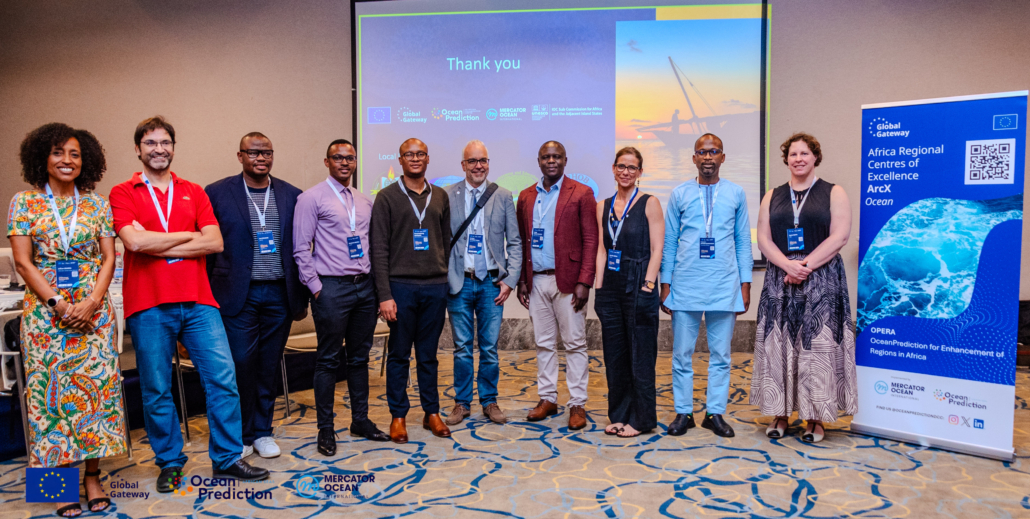
The OOFS alongside the Applications consortium members captured after the opening session together with the OPERA project manager Dr Lilian Diarra on the far left.
The European Union has committed 10 million Euros, for the 2025-2029 period, to support the creation of the OPERA project under its African Regional Centres of Excellence (ArcX) programme for science, innovation and technology for sustainable development. The OPERA project is divided into separate workstreams, two of which aim to establish African regional centers of excellence related to operational ocean forecasting systems (OOFS) and downstream applications to support coastal resilience and Africa’s Blue Economy through the establishment of dedicated consortia: one OOFS consortium and two applications consortia. R15 million is committed to the the OOFS consortium that is spearheaded by South African Environmental Observation Network (SAEON) led by Jennifer Veitch, with consortium partners: the University of Ghana (led by Joseph Ansong), the Kenya Meteorological Department (led by Phillip Ochieng), the South African Weather Service (led by Ramontsheng Rapolaki) and the Mauritian Department for Continental Shelf and Maritime Zones Administration and Exploration (led by Arshad Rawat). The forecasting consortium is supported by NOWSystems (Marcos Sotillo and team) who will be involved with the co-design of the regional (covering a large part of Sub-Saharan Africa) and coastal forecasting systems that will support the development of fit-for-purpose downstream applications. Leo Chiloane and his team at the Ulwazi node will provide data management support to ensure that the datasets are open and FAIR (Findable, Accessible, Interoperable and Reusable).
Two applications consortia have been established to integrate the regional forecast outputs into decision support tools for west and south/east Africa. The University of Ghana (led by Philip-Neri Jayson-Quashgah) will be developing applications related to early warnings (flooding, storm surge, and dangerous swell conditions) and marine coastal planning, related to shoreline change scenarios. Focussing on south and east Africa, South Africa’s Council for Scientific and Industrial Research (led by Sives Govender) will develop applications related to marine pollution tracking (including plastics, oil spills, bacterial pollution) and coastal inundation.
The OPERA project aligns with various African policy frameworks, including African Blue Economy Strategy, Agenda 2063, African Integrated Maritime Strategy and African Decade Roadmap and has the support of the African Decade Task Force, IOC Africa as well as GOOS Africa who are represented on the advisory board.

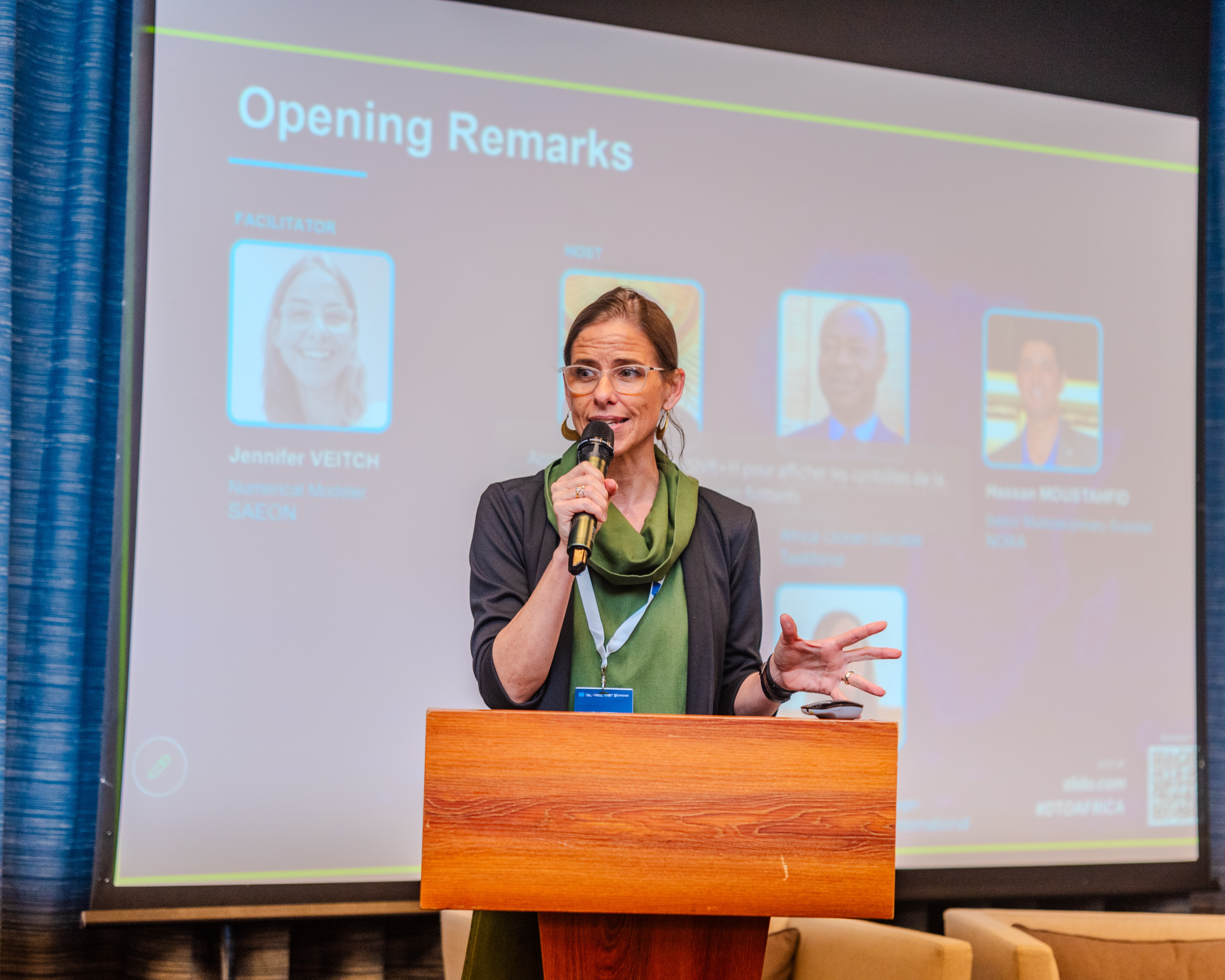
Jennifer Veitch, Leo Chiloane and Nkululeko Memela, the SAEON staff members attending the OPERA & African Digital Twin Workshop in Cotonou, Benin.
African Digital Twin Workshop:
A digital twin of the ocean is a digital replica of the ocean that incorporates ocean observation datasets, numerical models and AI approaches to produce easy to access information that supports decision-making. The African Decade Taskforce highlighted a Digital Twin for Africa as one of its nine priorities in the Ocean Decade Roadmap. Led by Hassan Moustahfid, vice-chair of the taskforce, the concept note for the implementation of an African Digital Twin was produced and was the focus of an engaging and interactive workshop following the OPERA event. The workshop was designed to provide input to a roadmap for establishing an interoperable, African-led digital ocean ecosystem that drives climate resilience, sustainable ocean governance and a thriving Blue Economy. It brought together multidisciplinary stakeholders, including government representatives, technical experts and early-career ocean professionals to discuss various aspects related to the implementation of digital twins. Ultimately, the output of the discussions will support the development of a regional implementation framework that will foster data sovereignty, leveraging local high performance computing (HPC) infrastructures and strategic partnerships such as OPERA.
Enrique Alvarez Fanjul, co-ordinator of the Ocean Prediction Decade Collaborative Centre, Mercator Ocean International, stressed that OPERA is an opportunity for Africa to connect around ocean forecasting and to establish a sustained regional excellence and services. While Ibukun Adewumi, head of UNESCO’s IOC Subcommission for Africa, reminded the delegates to keep three questions in mind as we develop actionable ocean information as part of OPERA and to be integrated into an African digital twin:
1. What questions do our interventions help the stakeholders to answer?
2. What will make our science trustworthy?
3. What capability will remain in Africa?
The SAEON OPERA team is excited to be addressing these questions as we work with our African partners to co-develop sovereign, sustained and fit-for-purpose digital assets that support informed decision-making.
