eNews
#05 2025
Seed Physiology Summer School: A solo leap to Germany
By Lanja Oosthuizen, MSc student and Prof. Dave Thompson, Scientist, SAEON Ndlovu Node
#05 2025
By Lanja Oosthuizen, MSc student and Prof. Dave Thompson, Scientist, SAEON Ndlovu Node
Grassland restoration efforts have historically prioritised reintroducing grass species for maintaining productivity rather than restoring overall ecosystem functioning. Forb (wildflower) species – which contribute the bulk of diversity and ecosystem services in these systems, have been neglected in restoration initiatives as they are difficult to germinate, often require dormancy alleviation, and rarely establish naturally in the field.
As an MSc candidate in the Forb Ecology Research Group at North-West University (Potchefstroom, South Africa), I embarked on a journey towards an improved understanding of forb seed germination. My research, under the supervision of Professors Frances Siebert, Stefan Siebert and Dave Thompson, involves assessing the viability, dormancy and germination potential of the seed of 50 indigenous forb species chosen to represent dominant plant families in South Africa’s highveld grasslands. With little previous research having been conducted on these wild species, or on South African forbs more generally, I actively sought opportunities to deepen my expertise in seed ecology, and in seed physiology especially.
I began an academic journey of a different sort when I was accepted as one of eight international students to attend the Applied Seed Physiology summer school hosted by the University of Hohenheim and the Leibniz Institute of Plant Genetics and Crop Plant Research (IPK) in Germany from 4 to 29 August. I am immensely grateful to Prof Thompson for the funding that made my attendance possible.
During the course, I gained extensive knowledge and hands-on skills in assessing seed quality and productivity, a crucial field for global food security, conservation and restoration. The module provided specialised theoretical and hands-on training in the assessment of seed moisture, germination, dormancy, vigour, priming and viability. I particularly enjoyed evaluating seed viability using visual techniques such as tetrazolium staining and the resazurin reaction, both of which indicate metabolic activity within the seed embryo.
My laboratory skills saw a drastic improvement in applying seed priming treatments using bacteria, and subsequent RNA extractions and qPCR analysis. Furthermore, presenting a poster and producing a podcast showcasing a chosen seed technology, significantly enhanced my presentation and communication skills.
The lectures on seed physiology of wild species provided me with fresh insights against which to interpret the findings of my own research. This new context has directly resolved some unanswered questions in my current MSc write-up.
Outside of the academic schedule I fully immersed myself in German culture and connected with people from various nationalities, including India, Namibia and Canada. Together, we explored famous Stuttgart landmarks, including the Wilhelma Zoological-Botanical Garden, Schlossplatz (Palace Square) and the Mercedes-Benz and Porsche museums.
We enjoyed the city’s beautiful parks and gardens, often indulging in the signature German Doner kebab and fresh baked treats. A personal highlight was visiting the IPK’s genebank in Gatersleben, one of the largest worldwide, with 151 000 accessions and almost 3 000 species, which was truly extraordinary. We also took a fascinating class trip back in time to Quedlinburg, a medieval town from the 1600 and now a UNESCO heritage site, where we roamed the historic streets.
It was great to engage and learn from experts and connect with other international postgraduate students in a collaborative work setting. This experience has not only better equipped me to complete my MSc dissertation this year but has also inspired me to pursue possible PhD opportunities and even a career in seed science and technology where I would get to engage my passion to harness the power of seeds. That seed is well and truly planted!
Attending this summer school was an incredible privilege, and I look forward to being able to use my newfound knowledge and skills for the betterment of seed-based restoration efforts back home in South Africa. I encourage every young scientist to pursue similar opportunities; you never know what the outcome may be. You might just get accepted, go on an academic and physical journey, and have the experience of a lifetime.
And yes, you can do it completely solo.
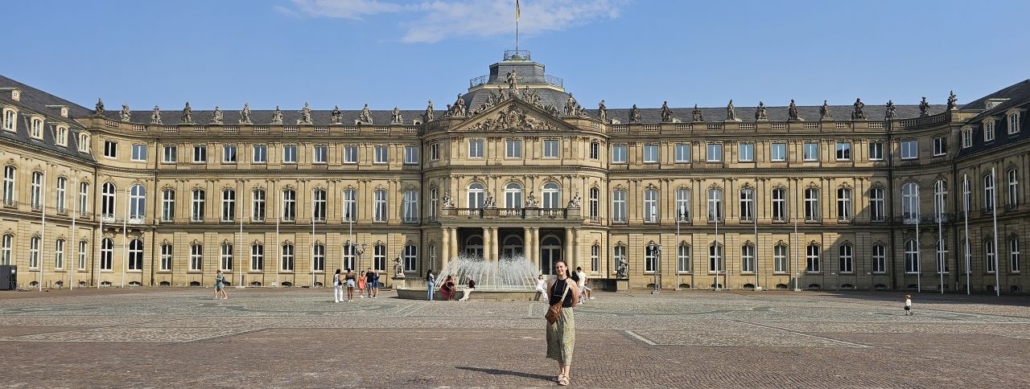
Visiting the Palace Square, known as the Schlossplatz, in Stuttgart.

MSc student Lanja Oosthuizen has embarked on a journey towards an improved understanding of forb seed germination.

Preparing for RNA extractions and qPCR analysis in the Leibniz Institute of Plant Genetics and Crop Plant Research laboratory.

Root and shoot lengths are measured to gauge the effect of seed priming and dormancy-alleviation treatments on germination success and seedling vigour.

Uniform tetrazolium staining (red) of metabolically active tissue indicates embryo and seed viability in two indigenous highveld grassland species, Hibiscus trionum (above) and Ipomoea oblongata (below).


In front of the Mercedez-Benz museum, with a bronze sculpture of five-time Formula 1 champion, Juan Fangio.

Roaming the streets of Quedlinburg, Germany.
