eNews
#05 2025
Small ocean drifters with an important role: Exploring marine cladocerans at SAEON/SMCRI’s Sentinel Site
By Danielle Chetty, Dr Mfundo Bizani and Dr Shaun Deyzel, Elwandle Node, NRF-SAEON

#05 2025
By Danielle Chetty, Dr Mfundo Bizani and Dr Shaun Deyzel, Elwandle Node, NRF-SAEON
The Shallow Marine and Coastal Research Infrastructure (SMCRI) under NRF-SAEON’s Elwandle Coastal Node, has been conducting monthly pelagic ecosystem long-term ecological research (PELTER) in the Algoa Bay Sentinel Site since 2007.
Monitoring zooplankton forms part of the PELTER programme. Zooplankton are tiny, microscopic animals that drift in the ocean and are a source of food for fish, whales and many other marine animals. Despite their small size, zooplankton are highly diverse and contribute significantly to energy transfer by providing the link between phytoplankton and larger marine organisms.
Among these zooplankton are marine cladocerans (Crustacea: Diplostraca – formerly known as Cladocera), commonly known as water fleas.
Cladocerans graze on phytoplankton and provide an important food source for fish and other marine organisms. They are able to reproduce rapidly when conditions are favourable, often resulting in population “blooms”. When this occurs, cladocerans can outnumber copepods which usually dominate marine zooplankton groups. Their sensitivity to environmental factors makes them useful indicators of environmental change, which is particularly important in the light of climate change.

“Normal” copepod-dominated zooplankton sample.

Cladocera population “bloom”.
This study investigated the abundance of cladocerans in response to environmental drivers from October 2024 to April 2025, from sampling stations PELTER 1 to 8 in Algoa Bay (Figure 1). Zooplankton data from SAEON’s PELTER programme was used, coupled with environmental data such as temperature, which enabled trends in cladoceran occurrence, abundance and population blooms to be explored.
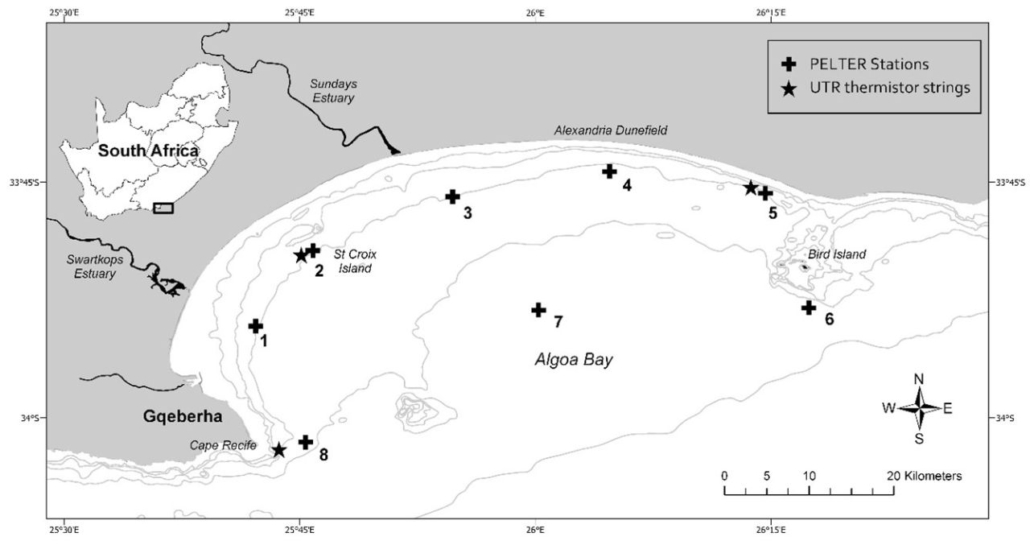
Figure 1: Map of Algoa Bay showing the location of sampling stations PELTER 1 to 8.
A warming event occurred between December 2024 – February 2025, during which maximum temperature reached 23.51 °C in January 2025 (Figure 2). This peak in temperature coincided with a peak in cladoceran abundance (5 808 ind.m-3). Notedly, copepod abundance dominated for most of the study period except during the warming event where cladocerans succeeded copepods in dominance (Figure 3).

Figure 2: Vertical profiles of temperature (°C) from October 2024 to April 2025, from surface to 30-m depth, showing the extent of warming over time and throughout the water column.

Marine biology assistant Danielle Chetty operating the ZooScan, a digital plankton imaging system.
Other environmental factors such as salinity, fluorescence, dissolved oxygen and turbidity remained fairly constant and showed no changes during the study period (data not shown). Therefore, temperature remained the key driving force for this population “bloom”. Although not considered in this study, factors such as food availability, water-column stratification and predation pressure have been reported to influence cladoceran population dynamics as well.
Three species (Evadne nordmanni, Penilia avirostris, Pseudevadne tergestina) and one family (Podonidae) of cladocera were found throughout this study (Figure 4).

Figure 3: Abundance (ind.m-3) of Copepoda and Cladocera from October 2024 to April 2025, with mean temperature (°C) superimposed (line plot).

Figure 4: Marine Cladocera found during this study period.
Of these, only Evadne nordmanni and Pseudevadne tergestina contributed to the population bloom (Figure 5). The most noticeable peak in abundance of cladocerans was recorded at PELTER 3, off Sundays River Estuary, in January 2025, which could be attributed to nutrient run-off from the river providing a conducive environment for cladocerans to flourish.

Figure 5: Abundance (ind.m-3) of Copepoda and Cladocera from October 2024 to April 2025, with mean temperature (°C) superimposed (line plot).

Danielle in NRF-SAEON’s zooplankton lab.
Temperature has a strong influence on cladoceran populations. Rising sea surface temperature has been linked to their successful colonisation and increased abundance. Therefore, increased warming events due to climate change may shift dominant zooplankton from copepods to cladocerans. Such a shift could ripple through and impact marine ecosystems.
Understanding the ecology of cladocerans is not only important for marine science but also for fisheries and food security, since cladocerans are a source of food for fish, and communities depend on fish for consumption. It is therefore important to understand the long-term implications of climate change on marine biodiversity.
Long-term monitoring programmes such as SAEON’S PELTER programme provides crucial data on marine ecosystem changes, including responses to extreme events. Continued research on overlooked yet ecologically important organisms such as cladocerans will improve our ability to anticipate and respond to environmental change in the world’s oceans.
