eNews
#02 2026
EFTEON taking initiatives for the ESKOM expo data handling workshop in the Klein Karoo and Garden route region
By Makgethwa Masemola
#02 2026
By Makgethwa Masemola
The Eskom Expo for Young Scientists is South Africa’s main national science fair for school learners. It encourages learners in grades 4-12 and TVET students (NC(V) Levels 2-4) to investigate, invent, and undertake research projects in Science, Technology, Engineering, Mathematics, and Innovation (STEMI). Students submit projects in 13 different categories that includes, environmental studies, agricultural sciences, computer sciences, energy, engineering, , and biomedical sciences amongst many.
Annually, the ESKOM Science Expo for Young Scientists hosts a science fair where school learners have a chance to showcase their own scientific investigations. The fair aims to develop young scientists who can identify a problem, analyse information, find solutions, and communicate their findings effectively. Many underprivileged schools struggle to provide students with a high-quality science education. Learners in such schools frequently lack the tools to develop suitable research topics independently. This includes inadequate lab equipment, overcrowded classrooms, well informed teachers, a lack of educational materials/tools and improper access to information. This often-hinder students from participating, competing and winning in the Expo fairs. The confidence and technical vocabulary required to successfully present their work to judges is also developed through such practical experiences.
The science fair organizes regional workshops on a regular basis to provide learners with research methodologies, while empowering educators with training on how to effectively guide the young scientists. After attending an exhibition for the Eskom Expo regional fair in George in 2025, it was observed that student from underprivileged schools had vague topics, no data and data analysis for their observational studies.
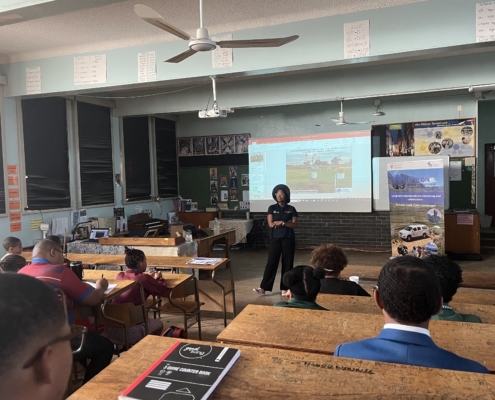
Oudtshoorn (Aurial College)
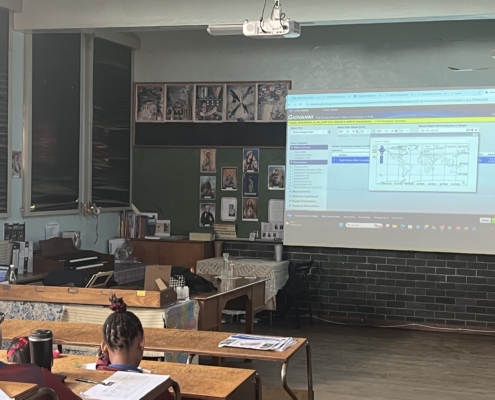
Oudtshoorn (Aurial College)
This prompted EFTEON to assist the 2026 learners in improving their projects through going beyond a textbook only and theoretical approach, to an environment where learners can perform experiments, test ideas, and visualize scientific concepts. A three-day workshop was held for Oudtshoorn (Aurial college), George (Inkcubeko Youth and Science Centre) and Knysna (Knysna high school) learners on the 13-16 April 2026 to introduce them on how to conduct research, starting up with formulating a question, proposing a title, showcasing tools that can be used to access and download environmental data with the related analysis that can be performed using MS Excel.
Learners who focused on topics such as “Air pollution, climate change and greenhouse emissions” in the 2025 science fair were guided on how to narrow a broad subject into a clear, researchable investigation. i.e. (For air pollution) It was emphasized that a strong scientific project begins with a specific, answerable question. Key questions included: (1) Which pollutant is being studied, such as SO₂ or PM2.5? (2) What is the source of the pollution – for example, vehicle traffic on a busy road or wildfires? (3) What measurable impact is being investigated, such as environmental damage or public health effects like asthma-related hospitalizations? (4) Who is affected, particularly vulnerable groups in specific local areas, such as children in low-income neighbourhoods or communities near industrial zones? Similar guiding questions were also applied to climate change and greenhouse gas topics.
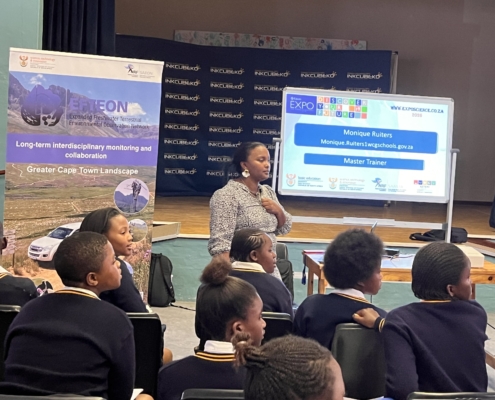
George (Inkcubeko Youth and Science Centre)
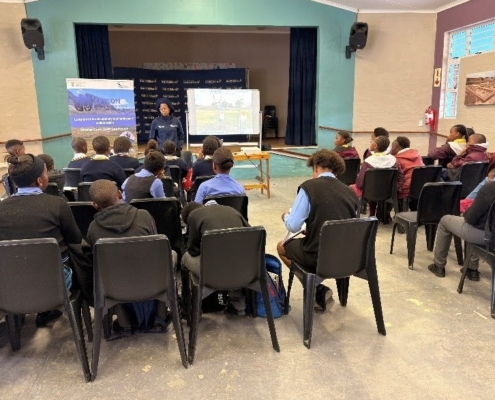
George (Inkcubeko Youth and Science Centre)
Learners were made aware of tools used for climate and air quality related topics, where data can be accessed, as well as institutions that can provide such data (i.e. SAEON, ARC, SAWS, SAAQIS, SANParks, municipalities, provinces). The use of air pollution and weather station data by the learners allow them to gain knowledge in gathering, organizing, and processing real-time data. Using environmental data from their own selected areas, they created graphs, charts, and data models to practice applying math and ICT skills. Earth Observation Satellite data was also introduced for those areas with no infrastructure for environmental data and Giovanni data product (https://giovanni.gsfc.nasa.gov/giovanni/ ) was used as it was the easiest for school learners. These assisted learners transform abstract concepts into tangible, real-world visualizations and empowered them to act as local environmental scientists using authentic data. EFTEON assisted the learners in determining what would make this scientifically significant rather than superficial. Instead of simply comparing pollution levels in towns, the following were suggested:
Examine NO₂ patterns during peak holiday seasons in George or Mossel Bay (traffic-related hypothesis).
Compare satellite NO₂ in George (where SAAQIS station exists) to satellite NO₂ in a town without a station and discuss limitations.
Compare seasonal patterns of aerosol (AOD) in Mossel Bay vs Oudtshoorn (coastal vs inland basin). That becomes a meteorology question.
Examine fire season impacts on Knysna and surrounding Garden Route region using aerosol index or AOD.
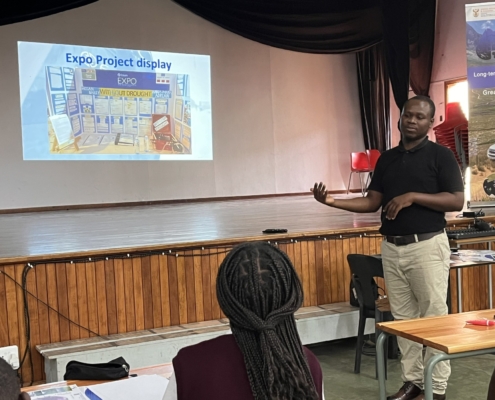
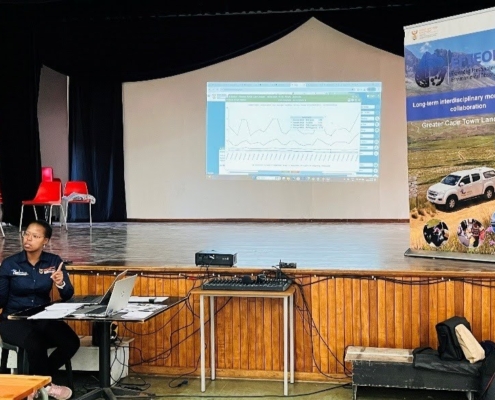
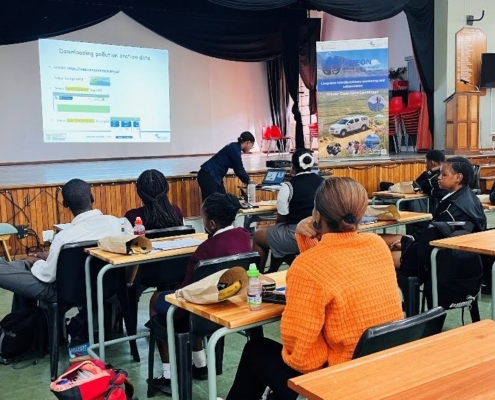
Furthermore, the limitations to the use of satellite data were discussed such as the presence of cloud cover reducing the data availability amongst others. This was not only informative to the learners but the teachers as well. A concern from one of the teachers was that, when learners fail with competitive projects in the regional competitions, they usually drop that project and go to a different category the following year, which disadvantages them more because they still would not have received proper mentorship for the new project category. The significance of mentoring such learners in participating in scientific fairs exposes them to benefits such as scholarships and potential STEM career options that they might not have previously considered.
