eNews
#02 2026
Coastal Observations Lab in a Box (COLaB): Democratising ocean sciences across the Indian Ocean
Authors: Jethan d’Hotman, Tamaryn Morris, Gregory Cowie, Juliet Hermes, Thomas Bornman
#02 2026
Authors: Jethan d’Hotman, Tamaryn Morris, Gregory Cowie, Juliet Hermes, Thomas Bornman
This article was originally published in the Indian Ocean Bubble accessible here: https://iioe-2.incois.gov.in/IIOE-2/pdfviewer_pub.jsp?docname=IIOE-2-DOC_OM_322.pdf
Ocean temperatures are rising, sea surface heights and acidity levels are increasing, along with more frequent extreme weather events across the Indian Ocean (Dalpadado et al. 2023). Yet despite this, the Indian Ocean remains a largely under-sampled and understudied region. One of the key challenges faced in ocean sciences is the limited access to equipment and expertise, particularly in low-income countries. This challenge is further compounded by a misconception that high-quality oceanographic observations require expensive equipment and large facilities.
Introducing COLaB.
The Coastal Observations Lab in a Box (COLaB) is built on a simple idea: high-quality coastal observations do not require state-of-the-art research vessels or laboratories. Using affordable, and where possible open-source, instrumentation, COLaB enables the measurement of a broad range of physical, chemical, and biological Essential Ocean Variables (EOVs). Rather than a one-size-fits-all approach, each box is co-designed with local partners, ensuring the suite of instruments and methods used are directly applicable to the questions and priorities of each region.
While technology plays an important role in COLaB, methods, training, and data sharing are fundamental to the project’s success. COLaB is working closely with the Ocean Best Practices system to ensure all methods are internationally recognised and adopted. All data collected through COLaB activities will be shared openly through ERDDAP servers, following FAIR principles. Training camps underpin all of this, ensuring that data collectors across the network are working from the same methodological foundation, supported by online resources and follow-up workshops that sustain data quality over time.
A core pillar of COLaB’s training philosophy is the empowerment of Early Career Ocean Professionals (ECOPs). Rather than simply transferring skills, COLaB will use a “train the trainer” model. Here the COLaB team will train ECOP representatives from various regions who will then become trainers in their own right and pass on their skills and knowledge to others in their region. This pay it forward model ensures capacity built through each camp continues to grow long after the camp has ended, thus creating a network of skilled coastal observers across the Indian Ocean.
The training camps are also designed to establish (or re-establish) long-term environmental monitoring sites at each location. The COLaB team will work with the local team to design and procure the necessary equipment (or Box) needed for this, equipping local teams with both the training and tools necessary to monitor their sites continuously and affordably.
COLaB has recently received formal endorsement from the Second International Indian Ocean Expedition (IIOE-2), recognising its contribution to IIOE-2’s core science themes spanning physical oceanography, biogeochemistry, ecosystem health, and capacity development. Through pilot camps already completed in Ghana and Kenya, COLaB has demonstrated its value in practice. The first major regional training camp is planned for Maputo Bay, Mozambique, later in 2026. From there, camps are planned for Malaysia, Bangladesh, the Andaman and Nicobar Islands, and Tanzania, with options being explored for Sri Lanka, Madagascar, Seychelles, Mauritius, and the Gulf region.
Ultimately, COLaB isn’t just about handing out equipment; it’s about shifting the lens of expertise. It allows those most affected by a changing climate to become the primary observers of their own blue backyards.
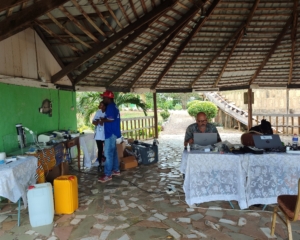
Laboratory setup at the hotel during the Pra river sampling
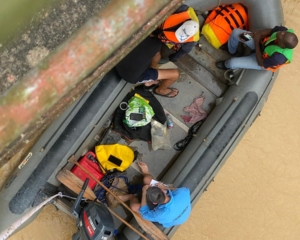
Aerial view of the boat collecting river discharge measurements across the Pra river.
