eNews
#04 2025
SAEON research showcased at landmark symposium in the Republic of Korea
By Daneeja Mawren, Riesna R. Audh, Clea Baker Welch and Juliet Hermes, SAEON Egagasini Node
#04 2025
By Daneeja Mawren, Riesna R. Audh, Clea Baker Welch and Juliet Hermes, SAEON Egagasini Node
At the forefront of ocean and polar research, scientists from NRF-SAEON and the University of Cape Town (UCT) are advancing our understanding of marine heatwaves, ocean-atmosphere interactions and polar biogeochemistry in the Southern Ocean. Through a combination of sustained observations, cutting-edge analytical techniques and strategic international collaboration, the team’s work is shedding new light on the drivers of ocean variability and the implications for regional climate, marine ecosystems and global ocean health.
Ongoing research includes the use of expendable bathythermograph (XBT) data to detect and classify subsurface marine heatwaves in the southwest Indian Ocean – a novel approach that challenges the traditional focus on surface-only temperature anomalies. Other studies are revealing the hidden biogeochemical activity within Antarctic winter sea ice, previously thought to be dormant during the polar night, while advanced altimetry and in-situ data analyses are helping to map thermocline heatwaves and link mesoscale ocean features to the intensification of extreme weather events like tropical cyclones.
This work was showcased at the BACO-25 Symposium held in Busan, Republic of Korea, in July this year. BACO-25 is a joint assembly of the International Association of Meteorology and Atmospheric Sciences (IAMAS), the International Association of Cryospheric Sciences (IACS) and the International Association for the Physical Sciences of the Oceans (IAPSO).
The event brought together leading scientists, early-career researchers and students from around the globe, under the auspices of the International Union of Geodesy and Geophysics (IUGG), to share advances in understanding Earth’s dynamic systems. Hosted by the Korean Meteorological Society, the Korean Society of Oceanography and the Geological Society of Korea, and supported by the Korean government and Busan Metropolitan City, BACO-25 served as a multidisciplinary platform for addressing the critical challenges facing our planet through the lens of atmospheric, oceanic and cryospheric sciences.
The SAEON delegation included Professor Juliet Hermes (manager of SAEON’s Egagasini Node), Dr Daneeja Mawren (postdoctoral fellow), Clea Baker Welch (MSc student) and Riesna R. Audh (SAPRI Polar Lab research coordinator). The team had the invaluable opportunity to present their research to an international audience.
Clea Welch presented her MSc research, which uses in-situ expendable bathythermographs (XBT) data to identify and classify subsurface marine heatwaves in the southwest Indian Ocean. This represents a novel application of XBT observations in marine heatwave research, offering valuable insight due to the data’s high spatial resolution and depth penetration.
Her findings reveal that marine heatwaves frequently extend well below the ocean surface, with many events occurring entirely at depth and exhibiting no detectable surface signal. This challenges the traditional surface-focused perspective of marine heatwaves and underscores the necessity of examining their full vertical extent.
Understanding the subsurface manifestation of marine heatwaves is particularly important given their potential to disrupt thermally sensitive marine ecosystems, alter habitat boundaries and impact organisms that reside beyond the surface mixed layer. By advancing knowledge of the vertical structure of marine heatwaves, this research contributes to a more comprehensive understanding of their ecological consequences and improves the detection of hidden thermal stress in the ocean interior.
Riesna R. Audh presented work done during her PhD that highlighted the field and lab protocols she helped to develop for sea ice sampling in the Antarctic Marginal Ice Zone. Her study focused on previously under-sampled winter sea ice and provided the first ever biogeochemical dataset for young and first-year sea ice in the region.
Riesna’s talk explored how measurements of sea-ice structure, isotopes, macronutrients and chlorophyll were used to investigate the processes that led to the formation of the sea ice sampled during the South African-led winter cruise in 2019. Her findings challenged the long-held assumption that winter sea ice is biogeochemically dormant, showing instead that the sea ice hosts an active biogeochemical environment.
Her study was further supported by numerical modelling that highlighted the influence on dynamic growth processes in the formation of the sea ice sampled and the resulting enhanced biogeochemical environment. By sharing these novel insights, her presentation showcased the valuable contributions of South African researchers to the global science community. It also demonstrated how South Africa’s strategic presence and research capacity in the Southern Ocean and Antarctic regions are helping to close major knowledge gaps and advance understanding of the polar regions.
Riesna’s presentation was awarded the IAPSO Eugene La Fond Medal, an award given to an ocean scientist from a developing country for outstanding research presented at an IAPSO-sponsored event.
Dr Daneeja Mawren, currently an HRA at SAEON, presented her postdoctoral research during the Indian Ocean sessions, highlighting work conducted on subsurface marine heatwaves in the southwest Indian Ocean. The findings showed that these extreme events, particularly in the thermocline layers, are often amplified and decoupled from surface expressions, making them harder to detect using only surface data. She also demonstrated how sea surface height extremes through altimetry data can serve as a useful proxy for identifying subsurface marine heatwaves, especially in regions where in-situ observations are limited.
Daneeja used the opportunity to initiate collaborative discussions with institutions such as KIOST and GEOMAR, aiming to strengthen research networks and promote the sharing of data related to marine heatwaves in the southwest Indian Ocean. She further engaged with other stakeholders in South Korea, such as the national institute of fisheries science, on how her approach could strengthen early warning systems and reduce the risk of compounding ecological and socio-economic impacts, particularly in vulnerable coastal and island communities.
Prof. Juliet Hermes delivered a presentation that demonstrated the value of sustained, high-resolution ocean observations for understanding regional climate extremes and improving air-sea interaction models. Her talk focused on the southwest Indian Ocean, using the case of Tropical Cyclone Kenneth to illustrate how ocean eddies influenced the storm’s rapid intensification.
Juliet also highlighted persistent biases in satellite and reanalysis products due to mesoscale variability in the Agulhas Return Current, emphasising the importance of in-situ mooring observations. Shifting to the Agulhas Current, she presented evidence from mooring and hydrographic data showing strong seasonal differences in nutrient transport onto the shelf, with important implications for coastal ecosystems.
The presentation was well received and contributed significantly to discussions on advancing climate prediction capabilities and ocean-observing strategies in the region.
During the executive committee meeting, Juliet took over as vice-chairperson of IAPSO. IAPSO plays a critical role in elevating physical and chemical oceanography by fostering global collaboration and supporting the participation of scientists from developing countries.
Presenting South African science in this forum not only affirms the international relevance of work done at SAEON and UCT but also strengthens the visibility and voice of the Global South in setting scientific agendas and addressing shared climate and ocean challenges.
Beyond the scientific exchange, the BACO-25 Symposium offered rich cultural experiences – from the vibrant opening reception to traditional meals and a visit to the iconic Haedong Yonggungsa Temple. Informal poster sessions – complete with fried chicken and local drinks – provided unique networking opportunities with peers from around the world.
The experience not only deepened our understanding of global oceanographic trends but also strengthened the presence of SAEON and the Global South in the international ocean science community.
The Egagasini team would like to thank NRF-SAEON and IAPSO for supporting their travel and participation in the conference.
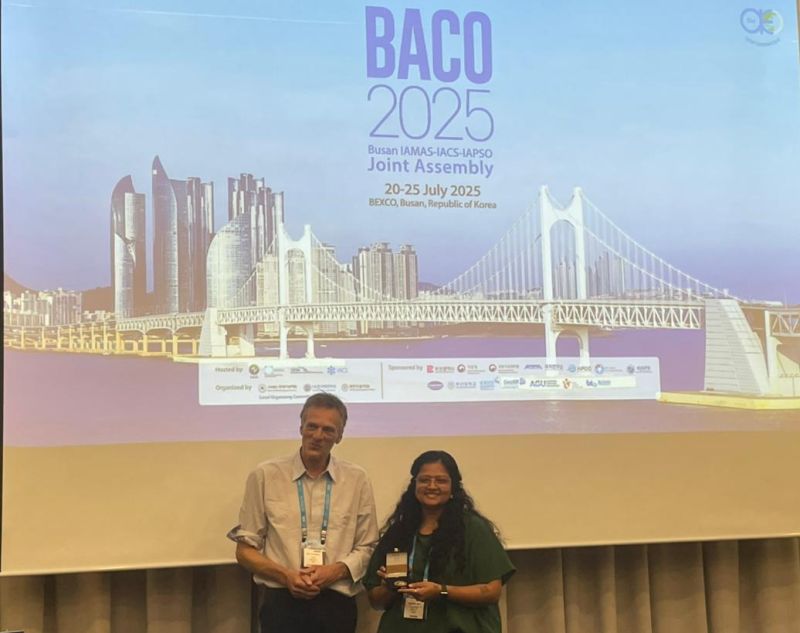
Riesna’s presentation was awarded the IAPSO Eugene La Fond Medal, an award given to an ocean scientist from a developing country for outstanding research presented at an IAPSO-sponsored event.
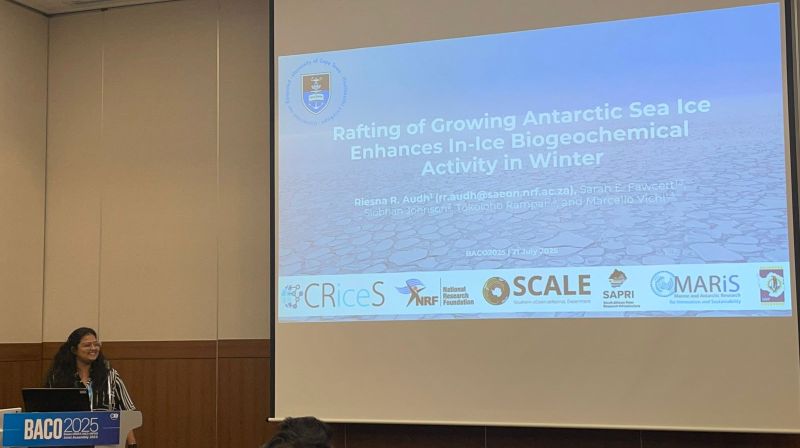
Riesna R. Audh presenting work done during her PhD that highlighted the field and lab protocols she helped to develop for sea ice sampling in the Antarctic Marginal Ice Zone.

The SAEON delegation included, from left, Prof. Juliet Hermes (manager of the Egagasini Node), Dr Daneeja Mawren (postdoctoral fellow), Clea Baker Welch (MSc student) and Riesna R. Audh (SAPRI Polar Lab research coordinator).

Clea Welch presenting her MSc research, which uses in-situ expendable bathythermographs data to identify and classify subsurface marine heatwaves in the southwest Indian Ocean.

Dr Daneeja Mawren presenting her postdoctoral research during the Indian Ocean sessions, highlighting work conducted on subsurface marine heatwaves in the southwest Indian Ocean.

Beyond the scientific exchange, the BACO-25 Symposium offered rich cultural experiences, from the vibrant opening reception to a visit to the iconic Haedong Yonggungsa Temple.
