eNews
#04 2025
An ecological forecasting initiative for Africa
By Jasper Slingsby
– Centre for Statistics in Ecology, the Environment and Conservation (SEEC), Department of Biological Sciences, University of Cape Town
– Fynbos Node, NRF-SAEON

#04 2025
By Jasper Slingsby
– Centre for Statistics in Ecology, the Environment and Conservation (SEEC), Department of Biological Sciences, University of Cape Town
– Fynbos Node, NRF-SAEON
Weather forecasts influence the decisions of millions of people every day, yet there are few forecasts of ecological phenomena to assist environmental decisions. While early weather forecasts inspired little confidence, over the past half a century or more, meteorologists have been producing forecasts and continually improving their precision, accuracy and duration of the forecast period. Adopting this iterative cycle of making forecasts and confronting them with new data has facilitated this learning and improvement. Ecology needs to do the same.
In a time of planetary-scale environmental crises, more than ever, managers and policymakers require evidence to inform their decisions, and tools to learn from the outcomes. Few decisions are once-off (should you burn, cull, harvest, restore, implement or retract a policy, etc.), and most are made repeatedly at some time-step (e.g. hourly, daily, monthly, seasonally, annually, decadally). While one should always evaluate and learn from the outcome of your decision, this does not always happen…
Iterative near-term ecological forecasts, with fully specified uncertainties, provide a framework to inform decisions and learn from outcomes. By collecting new data to evaluate the outcomes of decisions against the original model forecasts, we can update our prior knowledge and improve our ability to forecast and make decisions in the next time step. The new data can tell us whether our forecasts or decisions were any good, and whether we need to refine or replace our model, re-evaluate our assumptions or ecological understanding, consider additional scenarios or inputs, etc.
While early iterations of new forecasts may have low skill, the learning cycle ensures they will rapidly improve, and there are many other benefits. Forecasts aside, just the bioinformatics pipeline required to support iterative forecasts should be valuable to decision-makers in that they provide rapid access to the most recent data. This also adds value for long-term research and monitoring programmes in that new data are interrogated as they are collected, allowing platform managers to rapidly identify issues with equipment or data collection protocols. Ultimately, as the forecasts improve, they can support adaptive monitoring, highlighting key data needs required to reduce uncertainty in the forecasts.
The Ecological Forecasting Initiative (EFI; ecoforecast.org) was established in the USA in 2018 as an international grassroots consortium aimed at building and supporting an interdisciplinary community of practice around near-term (daily to decadal) ecological forecasts. EFI chapters have since been established in Canada, Oceania and Europe, and now in Africa.
Ecoforecast Africa (ecoforecast.africa), the recently formed African chapter, is in its founding phase, but has already grown to >60 members from across Africa and the world in just a few months (see ecoforecast.africa/join). Ecoforecast Africa had its first community call in May and ran its inaugural training event in Cape Town, South Africa, 21–25th July. The short course on iterative near-term ecological forecasting included 27 participants from South Africa, Kenya, Nigeria, Zimbabwe, Japan, Switzerland and the USA, including students, academics, decision-makers and consultants from several universities, conservation agencies, NGOs and environmental consultancies.
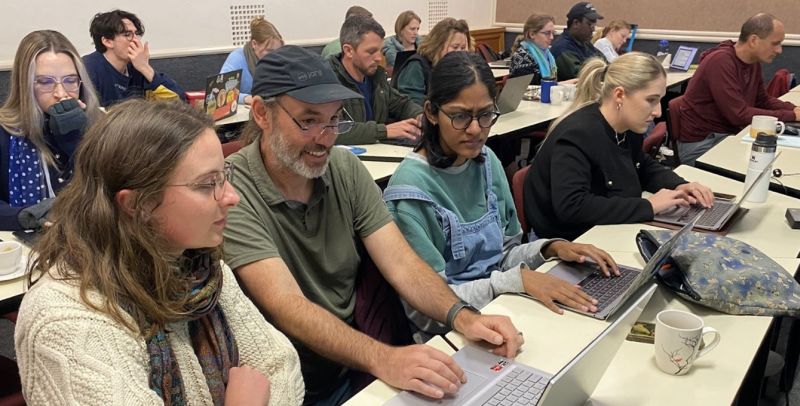
Prof Mike Dietze (second from left) assisting students during one of the hands-on exercises.
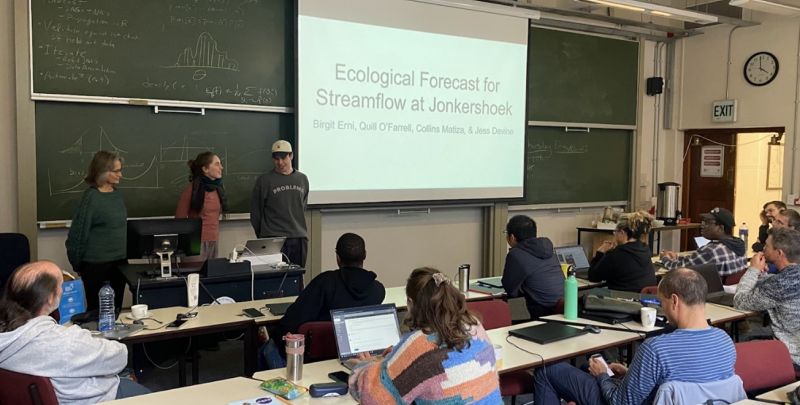
A team presents the outcome of their group project. All participants had to work on a group project throughout the week, developing an iterative ecological forecast for one of streamflow or eddy covariance from SAEON’s Jonkershoek long-term ecological research site (fynbos.saeon.ac.za) or waterbird counts from the Coordinated Waterbird Counts and BIRDIE projects.
The course was hosted by the Department of Biological Sciences and the Centre for Statistics in Ecology, the Environment and Conservation (SEEC; https://science.uct.ac.za/seec) at the University of Cape Town (UCT) and funded by the UCT Visiting Scholars Fund and SAEON; www.saeon.ac.za). Demonstration datasets were drawn from SAEON’s Jonkershoek long-term ecological research site (fynbos.saeon.ac.za) and the Coordinated Waterbird Counts and BIRDIE projects.
With instruction led by EFI founder and director, Professor Mike Dietze of Boston University, and supported by Dr Jasper Slingsby and Dr Murray Christian of UCT, the course aimed to introduce participants to the various components of making an iterative near-term ecological forecast.
Participants were taught how to generate a forecast from a simple model that makes use of more than one data stream, how to categorise and estimate the uncertainties in the model, propagate this uncertainty into the forecast, assess the performance of the model and discern ways to reduce uncertainty in the next iteration of the forecast. They should also be able to assess and critique forecast data products and scientific publications about ecological forecasts and understand how such forecasts can be used to inform decision-making. All course materials are available through the Ecoforecast Africa website at https://ecoforecast.africa/events/past/course_2025/.
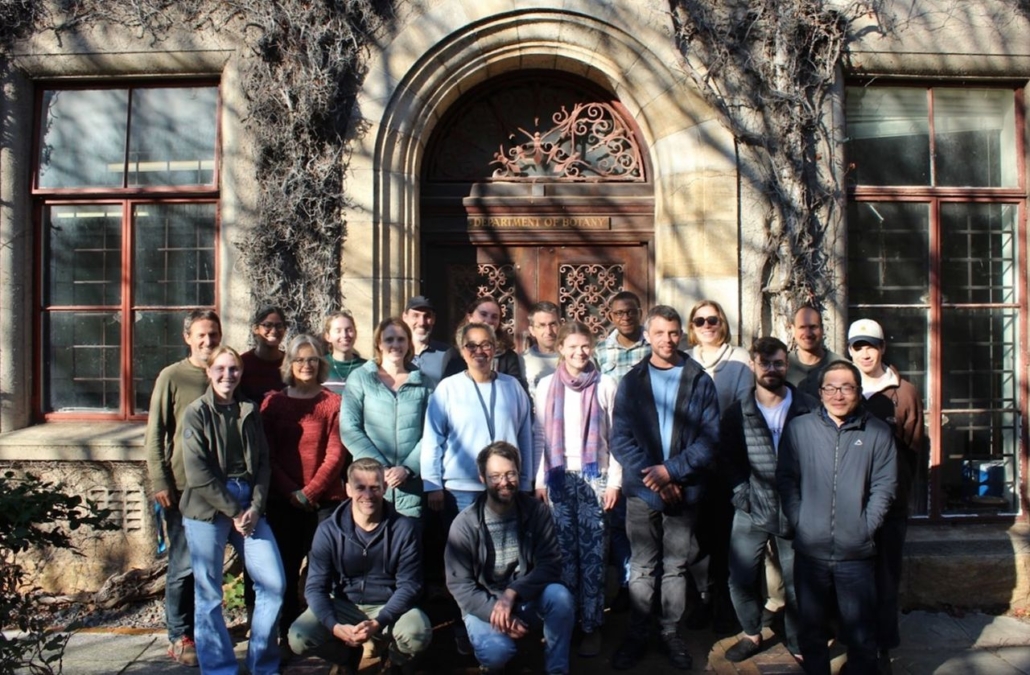
Course participants and instructors outside the Department of Biological Sciences, University of Cape Town.
The foundation phase of the chapter is focused on growing awareness, membership and representation across the continent. With the next online community call planned for October, key agenda items include planning further training events, arranging special sessions for upcoming international conferences that are to be held in Africa and developing a perspective piece on the needs and opportunities for near-term ecological forecasts in Africa.
If you think this is for you, please sign up at ecoforecast.africa/join!
