eNews
#01 2026
Findings from an Honours student’s novel research project
By Wynand Calitz from the SAEON Arid Lands Node
#01 2026
By Wynand Calitz from the SAEON Arid Lands Node
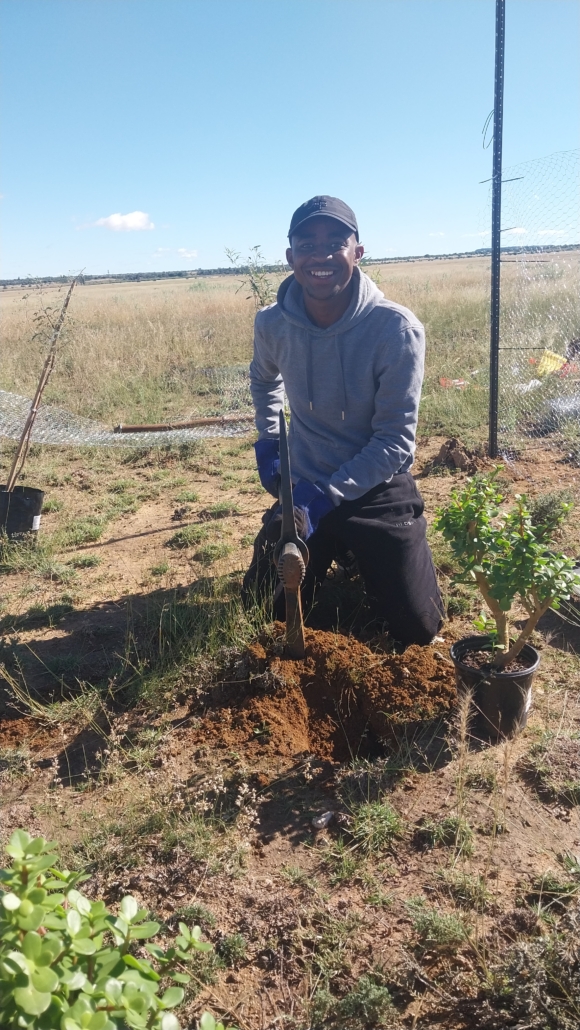
Morena digging holes in very hard calcrete to plant his trees.
In recent years, there has been a push from the government to plant trees throughout South Africa to mitigate climate change, as well as planting fruit trees and involving communities where possible. One of these initiatives is the Presidential Ten Million Trees Flagship Programme, which aims to plant 10 million trees in five years. There have also been discussions around planting of trees in the Karoo as this area has very sparse vegetation, largely attributed to overgrazing by livestock, which began with early settlers in the area. Portions of the Karoo have already received much attention in the rehabilitation space where Spekboom (Portulacaria afra) is being planted. However, little research has been conducted on the feasibility of planting trees in the Karoo, considering the harsh environment.
As mentioned, the Karoo has been prone to overgrazing for many decades exasperated by water scarcity. The water scarcity is a result of several factors including limited rainfall, overuse by towns and agriculture, exceeded grazing capacities, and invasive aliens. As such, the biome is in dire need of rehabilitation, but the science is still very limited. When planting trees (or any plants) in the Karoo, one needs to consider environmental conditions and how it may influence success, as these can have severe financial consequences.
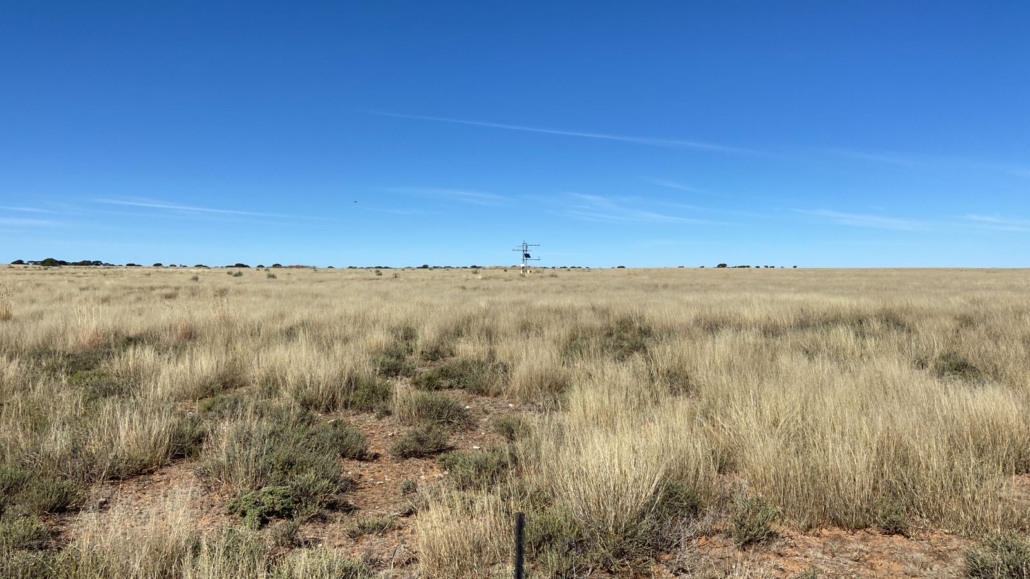
Grassy Karoo site at Benfontein Nature Reserve in the Northern Cape
The goal of the study was to assess the feasibility of planting trees in the Karoo. We focused on how herbivory and frost influence the growth of young planted trees. We sourced indigenous trees, that occur in various parts of the Karoo, from a local nursery. Although the Northern Cape falls outside of its natural distribution, Spekboom was selected due to its popularity in the carbon credits space known for its carbon sequestration properties, as well as being a keystone species that resprouts easily. Spekboom is already being used in Karoo rehabilitation projects, particularly in the Eastern Cape. The other two species used were Sweetthorn (Vachellia karroo), a common Karoo species, often occurring in riparian areas (along streams or rivers), and Red Karee (Searsia lancea), which occurs throughout the Karoo, but mostly in arid savanna areas in central South Africa. We set up a control plot at the Arid Lands Node offices at SANParks VWS, and two comparative in situ sites on the Benfontein Private Nature Reserve, an ALN research platform. For the in situ site, one plot was planted with trees in the open veld and the other we erected a fenced exclosure to exclude large herbivores. These three trials allowed us to determine the extent to which herbivory influences tree health.
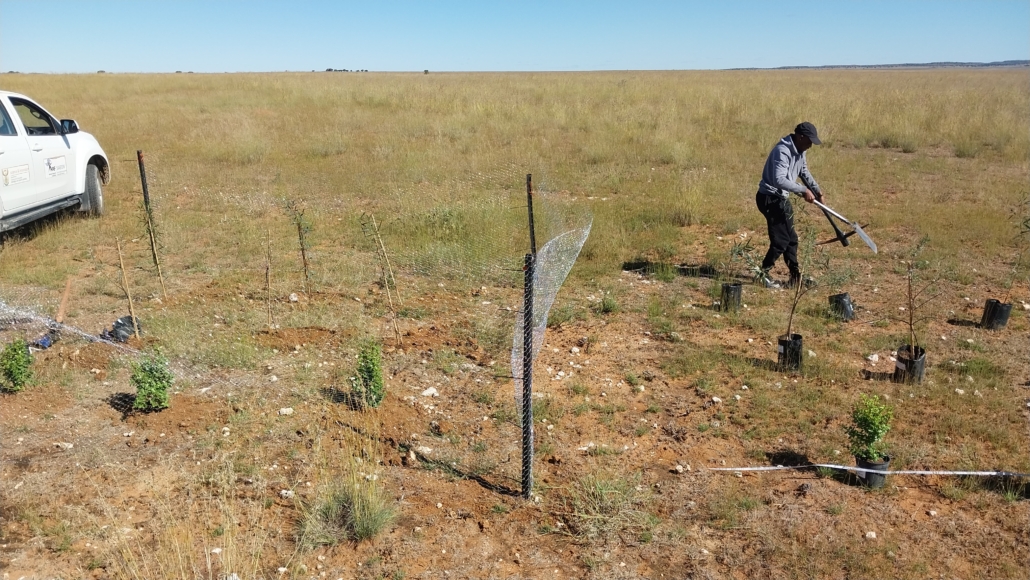
Experimental site being set up; exclosure on the left and open on the right.
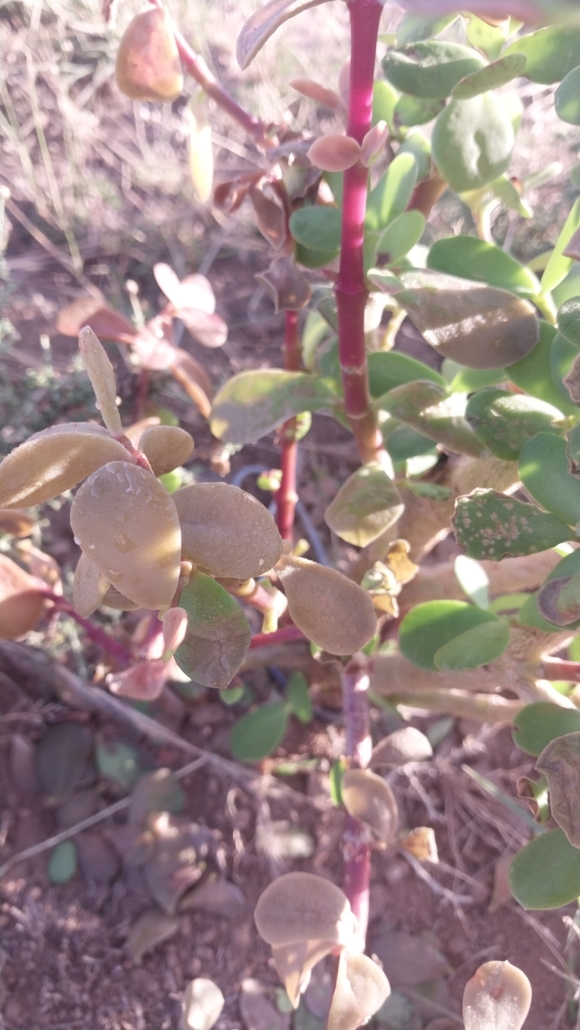
Frost damage on Spekboom.
Despite the secured locations chosen for the study, the first findings we had was that plants from the one site were stolen. This site was close and visible from the road and we suspect that made for an easy target. Even though the loss of the replicates were demoralizing, it provided valuable insights on site selection. We lost all of our Spekboom saplings due to frost and herbivory, with frost being the primary contributor. This was expected as previous research has shown how this species is susceptible to frost. Spekboom rehabilitation works in areas where a micro-climate can be created to protect it from frost as well as reducing the influence of herbivores, thus it can be costly for use in the Karoo. Both the Sweetthorn and the Karee had minimal frost damage, and only some of the Karee trees experienced high herbivory damage. Both these species showed strong resprouting capabilities following winter when it started warming up and the area experienced some rainfall. The Sweetthorn requires less investment in protection as it has some natural protection (thorns), but is slower growing and may require some watering to reach adulthood. The Karee showed great potential despite high herbivory, thus may do well where herbivory is limited or investment into temporary protection is possible.
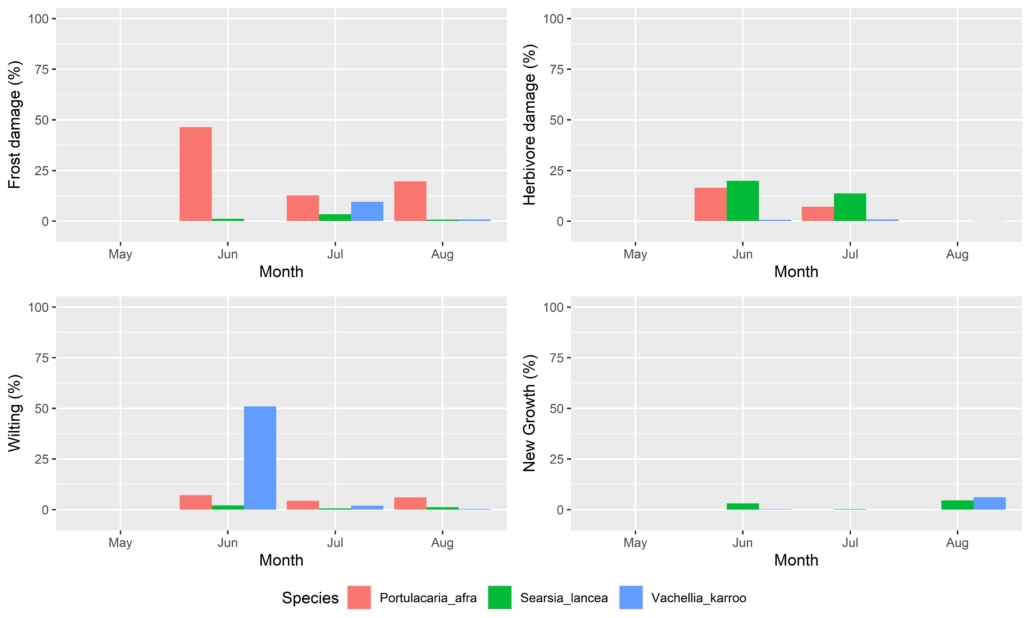
Some findings from the study.
Even though this study is at a very small scale, it provides valuable insights for future studies on the topic, and Morena learned a great deal about ecology. Large-scale studies following this design are recommended to provide the necessary science needed for decision makers when it comes to rehabilitation in the Karoo. It was also a good opportunity for SAEON to work with the local university. Morena and I would like to thank De Beers for allowing us to conduct research on their property.
