eNews
#01 2026
Modelling oil spills from ship-to-ship fuel transfers in Algoa Bay: a potential threat to the critically endangered African Penguin
By Giles Fearon, Senior Operational Ocean Modeller, Egagasini Node, NRF-SAEON

#01 2026
By Giles Fearon, Senior Operational Ocean Modeller, Egagasini Node, NRF-SAEON
The African Penguin was uplisted by the IUCN to Endangered in 2010 and most recently to Critically Endangered in 2024, making it the world’s most threatened penguin. This iconic species now teeters on the brink of extinction, beset by multiple threats. The greatest threat to their survival is the declining populations of sardines and anchovies, their primary food source, but the potential impacts of oil spills pose an additional threat to their survival, particularly given their low population at present.
The threat of oil spills to African Penguins is perhaps greatest in Algoa Bay, a key site for marine biodiversity and home to two of South Africa’s most significant seabird colonies: St Croix Island and Bird Island. Algoa Bay is also the site of offshore ship-to-ship (STS) fuel transfers, which have already resulted in four spills since operations began in 2016.
Given the increasing number of threats driving the African penguin population ever closer to extinction, the risk posed by STS transfer is a significant concern for scientists and conservation organisations. A team of researchers from SAEON, SANCCOB and Nelson Mandela University collaborated on a manuscript, recently published in the Marine Pollution Bulletin (https://doi.org/10.1016/j.marpolbul.2025.119089), to better understand the transport and concentration of oil from STS fuel transfer related spills and how this relates to impacts on seabirds.
STS transfer in Algoa Bay
STS transfer, also referred to as offshore bunkering, is the process of supplying fuel (bunkers) to ships at sea, away from traditional port facilities. The service, which is expanding at many ports worldwide, saves ships from having to berth, which is convenient in terms of both time and cost. However, these benefits come at the expense of the ocean environment and marine species that are exposed to the noise and disturbance caused by increased vessel traffic, and a higher risk of oil spills.
Algoa Bay is currently the only location along South Africa’s coast where offshore STS fuel transfer activities are permitted to occur. The main anchorage area for bunkering vessels is located close to St Croix Island, which used to be home to the world’s largest colony of African penguins. Less than a decade ago, St Croix was a refuge for thousands of penguins, but now the population has reduced by almost 90%, with only several hundred remaining.
The research study
The research paper draws on data from oiled seabirds admitted to SANCCOB for rehabilitation following four oil spill incidents related to STS transfers in Algoa Bay. Particular attention is given to the MV Chrysanthi S spill of 6 July 2019, where 400 L of Heavy Fuel Oil was spilled, leading to the admission of 92 oiled African Penguins and 10 abandoned chicks. This historical spill was modelled using SAEON’s high resolution ocean and oil spill model for Algoa Bay, developed as part of the national Ocean and Coastal Information Management System (OCIMS). The model was used to simulate different types of spills under varying weather conditions, different locations, and with different fuel volumes ranging from 400 L to 740 000 L.
Key findings
The results of the study show that core foraging areas for seabirds in Algoa Bay would have remained exposed to oil for up to a week after the MV Chrysanthi S spill event and that birds would have been found and rescued days after their contamination. In response to the prevailing ocean currents and weather conditions, future spills from the STS fuel transfers would have a high likelihood of resulting in both shoreline impacts as well as persistent surface contamination. The seasonal analysis indicated that surface impacts are higher during austral winter, when oil is more likely to impact the St Croix and Bird island core foraging areas, while shoreline impacts are likely to be higher in summer.
Importantly, this research indicates that even a very thin layer of oil on the sea surface can result in significant impacts to seabirds, particularly African penguins, as was observed during the the MV Chrysanthi S spill. This is likely due to the high amount of time spent on the water surface and lack of flying capability, pointing to the need for a high degree of conservatism when assessing the impacts of potential oil spills on African Penguins.
These findings underscore the urgent need for regulation of offshore bunkering in ecologically sensitive areas and improved preparedness for wildlife rescue and rehabilitation, especially in an area of such high biodiversity as Algoa Bay.
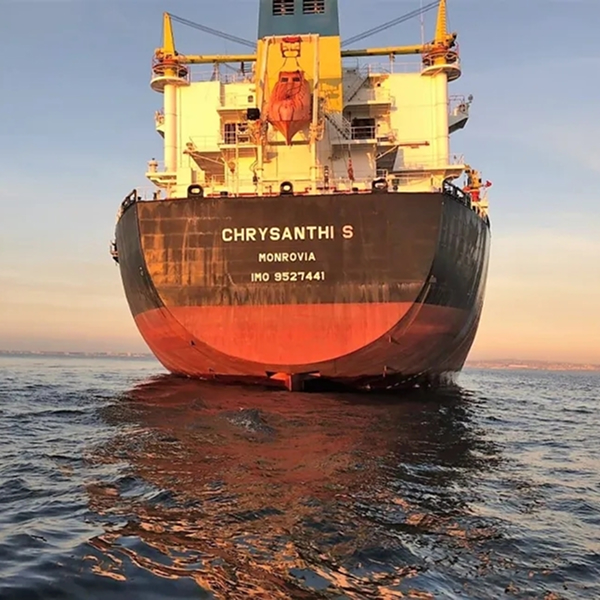
In 2019, a 400 litre oil spill resulted from refuelling on the MV Chrysanthi S. (Photo: SAMSA)
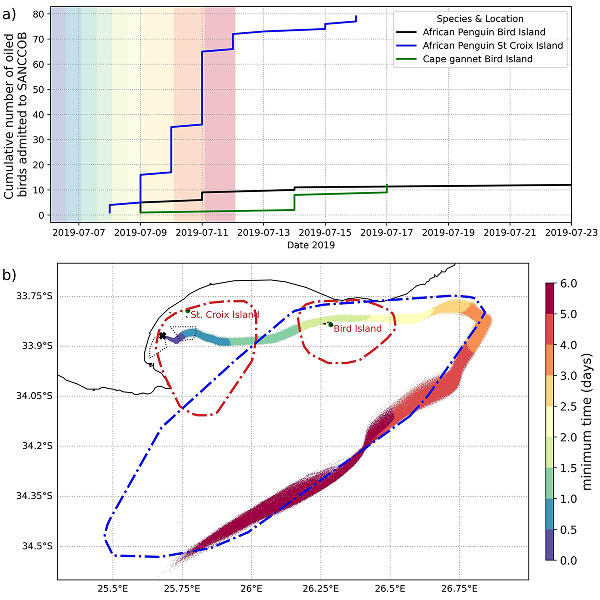
Observed number of oiled birds admitted to SANCCOB following the MV Chrysanthi S spill on 6 July 2019 (a) in relation to the footprint of the modelled spill (b). Dotted areas in b) represent the core foraging areas for African penguins (red) and Cape gannets (blue). Core foraging areas for seabirds in Algoa Bay would have remained exposed to oil for up to a week after the spill event. Birds were likely found and rescued days after their contamination.
