eNews
#04 2025
Tracking greenhouse gas fluxes in seagrasses and mudflats in South African estuaries
By Marelé Nel (SAEON), Lucienne Human (SAEON), Daniel Buttner (SAEON/NMU), Thomas Bornman (SAEON) and Janine Adams (SARChI/SWE)

#04 2025
By Marelé Nel (SAEON), Lucienne Human (SAEON), Daniel Buttner (SAEON/NMU), Thomas Bornman (SAEON) and Janine Adams (SARChI/SWE)
Carbon dioxide (CO₂), methane (CH₄) and nitrous oxide (N₂O) are potent greenhouse gases (GHGs) that significantly contribute to global warming. While CO₂ emissions often dominate climate change discussions, CH₄ and N₂O have substantially higher global warming potential and deserve closer attention.
South Africa’s coastal wetlands form an integral component of the blue carbon economy by creating habitats for fishes, improving water quality and, so doing, promoting fisheries. These ecosystems are internationally recognised for their carbon storage potential.
Although coastal wetlands provide many other beneficial ecosystem services that contribute to the socio-economic and environmental well-being of local communities and the environment, intertidal wetlands are being encroached upon by coastal development on the one side and sea level rise on the other. Seagrass beds, specifically, are also threatened by nutrient pollution, sedimentation, reduced water clarity and physical disturbances such as bait digging and boating.
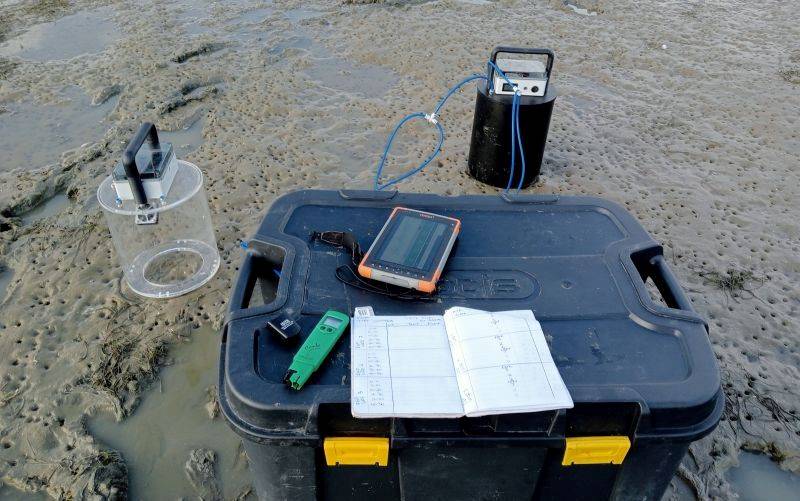
Chamber set-up with analysers on mud flat.
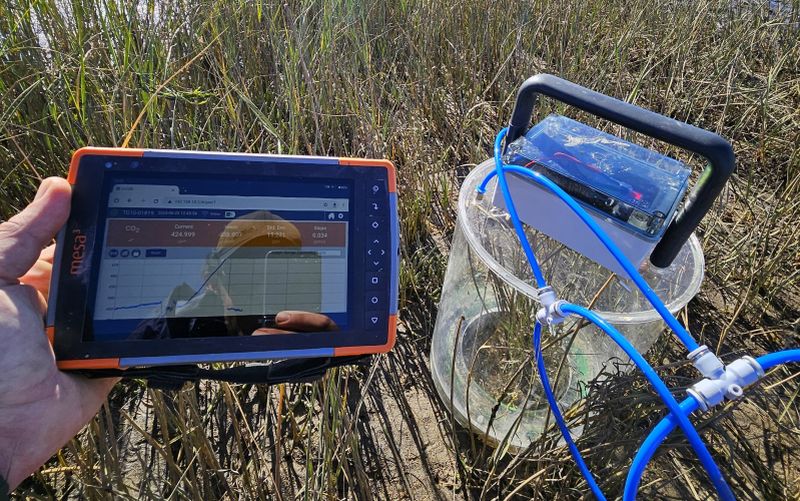
Chamber set-up with tablet on salt marsh.
In January to February and June to July this year, a team from the SAEON Elwandle Node conducted in-situ GHG flux measurements of seagrass and mudflats in three estuarine systems: the subtropical Nxaxo Estuary, the warm temperate Knysna Estuary and the cool temperate Berg Estuary. The GHG fluxes were measured within transparent and dark chambers, allowing us to isolate the impact of photosynthesis (in the light) from respiration (in both light and dark) and other processes to accurately estimate net ecosystem exchange (NEE).
In addition to the biomass carbon/nitrogen stock measurements, each individual flux site is paired with a 0.5-m metre deep sediment core. These cores are divided into sections and measured for carbon/nitrogen stocks, porewater and various sediment characteristics.
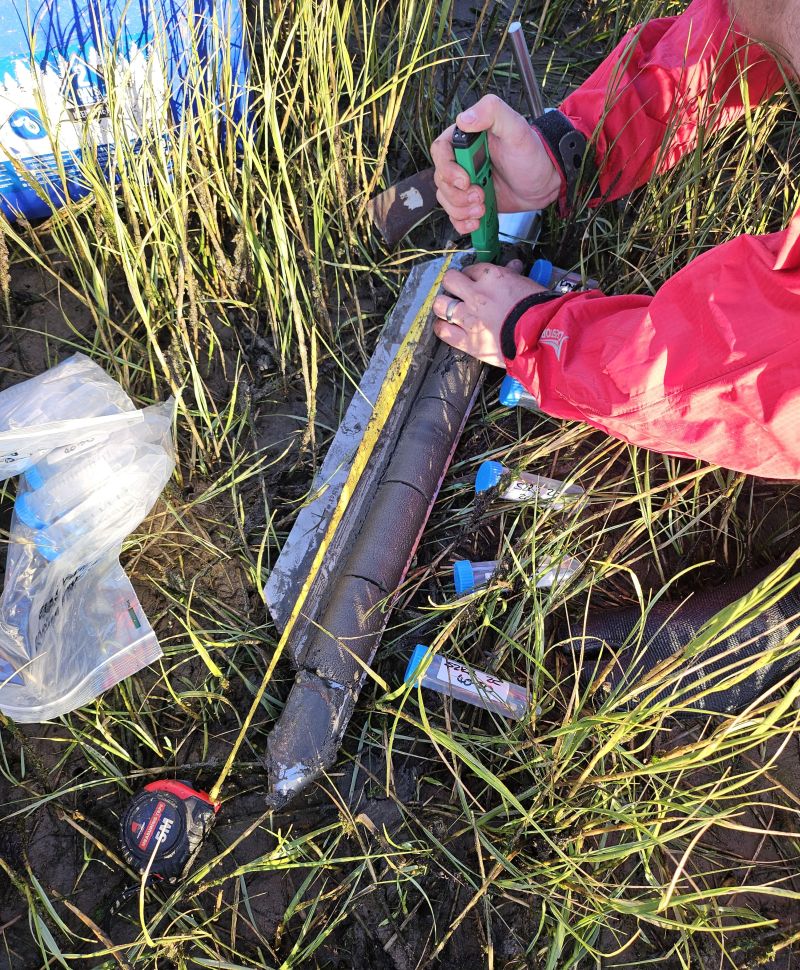
Cores with handheld probe.
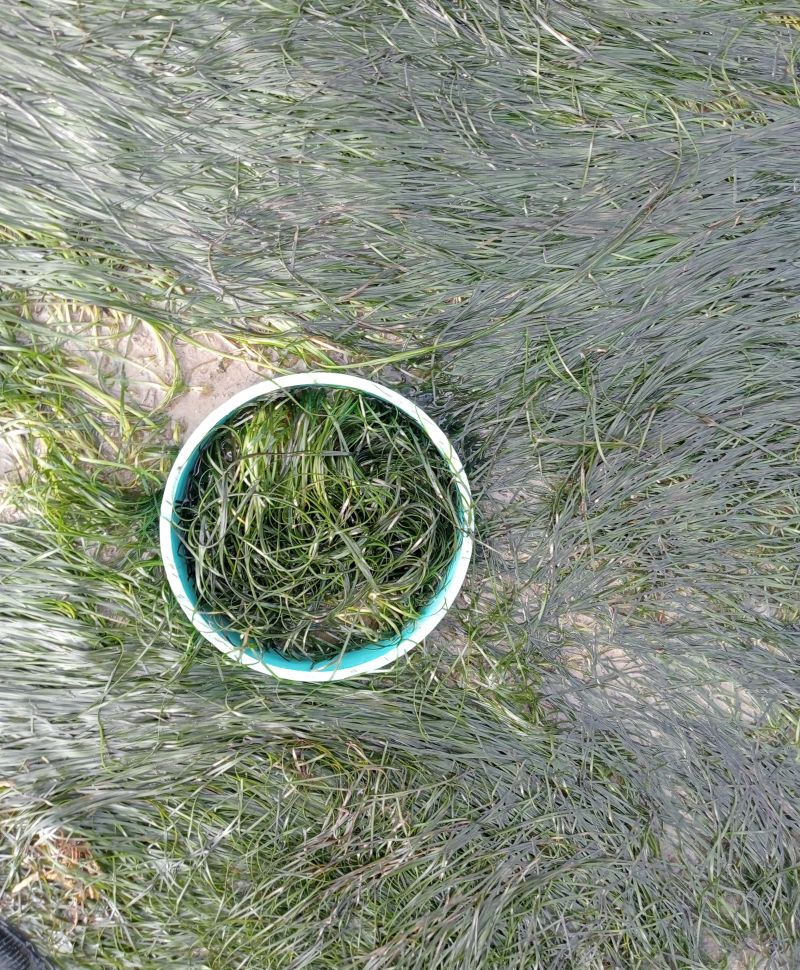
Seagrass replicate Berg Estuary.
Preliminary flux results from January–February 2025 suggest that the seagrass and mudflats show a general positive flux, meaning that they emit GHG into the atmosphere (Figure 1). This by no means negates the valuable contribution of these habitats to the blue economy, but it is a factor to consider when calculating the value of carbon and nitrogen stocks in coastal communities.
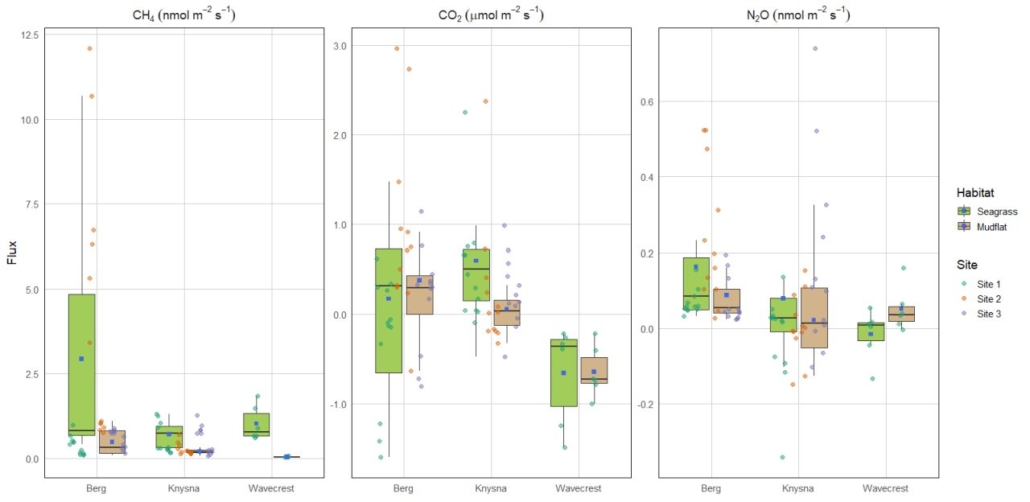
Figure 1: Boxplots showing median, mean (blue square), 10th, 25th, 75th, 90th percentiles and raw data points (circles) of the gas fluxes for seagrass meadows and mudflats in the Berg, Knysna and Nxaxo Estuaries for January–February 2025.
We are still in the process of analysing all the samples for their stocks for the seagrass and mudflat habitats. This will provide valuable data on the potential of our coastal wetlands to mitigate the effects of global warming, as well as provide positive incentive to protect these vulnerable habitats.
This work is part of ongoing research and forms part of the Long-Term Ecological Research (LTER) initiative coordinated by SAEON. All fieldwork, equipment and analysis were generously supported by the SAEON Elwandle Node.
We would like to thank the dedicated team of students, supervisors and staff involved in this project: Prof. Thomas Bornman, Dr Lucienne Human, Prof. Janine Adams, Daniel Buttner, Joel Greaves, Marelé Nel, Dr Phumlile Cotiyane-Pondo, Dr Athi Mfikili and Riaan Weitz.
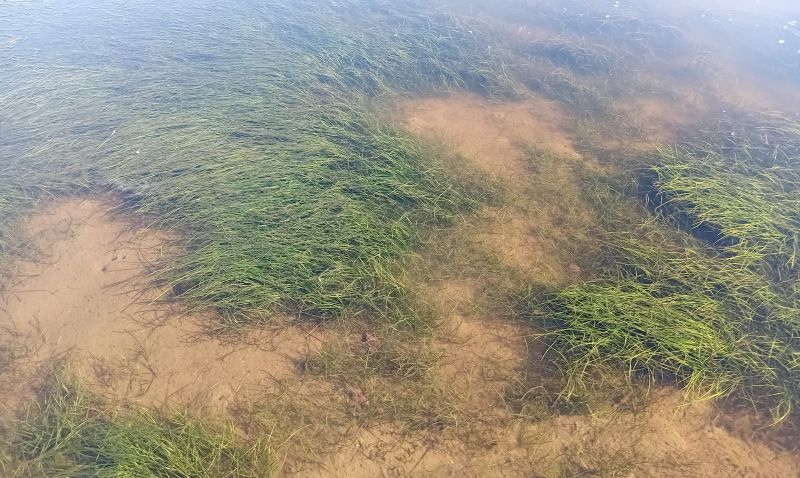
Seagrass meadow.
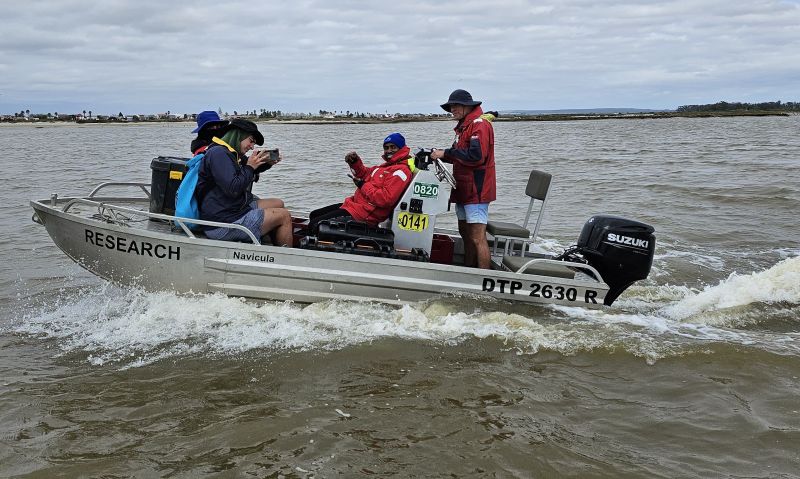
Research team travelling to sites.
